
Diego Ferreira, Features Reporter.
You are standing at the bathroom mirror with three half-empty mascara tubes lined up on the shelf, all bought because the box promised the same thing: fuller, thicker, bolder lashes by tonight. None of them quite delivered, and you are not sure if that was the formula, the brush, or the way you applied it. The question you actually type into a search bar is simpler than any of the marketing copy: does this stuff really make lashes look thicker, or am I just paying for a better-looking tube?
Here is the useful fact most packaging never states plainly: volumizing mascara does not make a single lash hair grow wider. It builds a coating, layer by layer, out of waxes, film-forming polymers and sometimes tiny fibres, until the lash reads as visibly denser to the eye. Once you understand that mechanism, most of the aisle’s noise falls away, and you can judge any formula on its own terms rather than on its claims.
- Volume is built, not grown: a mascara thickens lashes by layering wax and polymer film around each hair, so how it builds matters more than any single ingredient named on the box.
- The brush decides more than the formula: a wand’s bristle spacing and shape control how much product lands on the lash versus on your skin, which is why the same formula can perform differently in two different wands.
- A flaking or clumping mascara is usually a storage and age problem: most tubes dry out within three to six months of daily opening, and no amount of technique fixes a formula that has already gone tacky.
Why The Wand In The Box Never Matches The Wand On The Shelf

Packaging photography almost always shows the mascara wand at an angle and in soft focus, which hides its true bristle density. What looks like a plump, generous brush on the box can turn out, once uncapped, to be a slim cone with widely spaced bristles designed for length rather than volume.
This is not dishonesty so much as a category habit: length and volume formulas are often sold from near-identical tube shapes, and the only reliable difference is printed in small type on the side panel, or felt the moment you pull the wand out. If you shop at a counter, whether at Sephora, Douglas or Notino, ask if there is a tester you can uncap. If you shop online through a national Amazon storefront, read the product photos that show the brush head straight on, not the glamour shot on the front of the listing.
A rule that holds across brands: a fatter, tightly packed brush with bristles of varying length usually signals a volumising intent. A slim, evenly spaced brush is built for separation and length, and will rarely give you the density you are after, no matter what the front label says.
What Actually Thickens A Lash: Wax, Fibres And Film
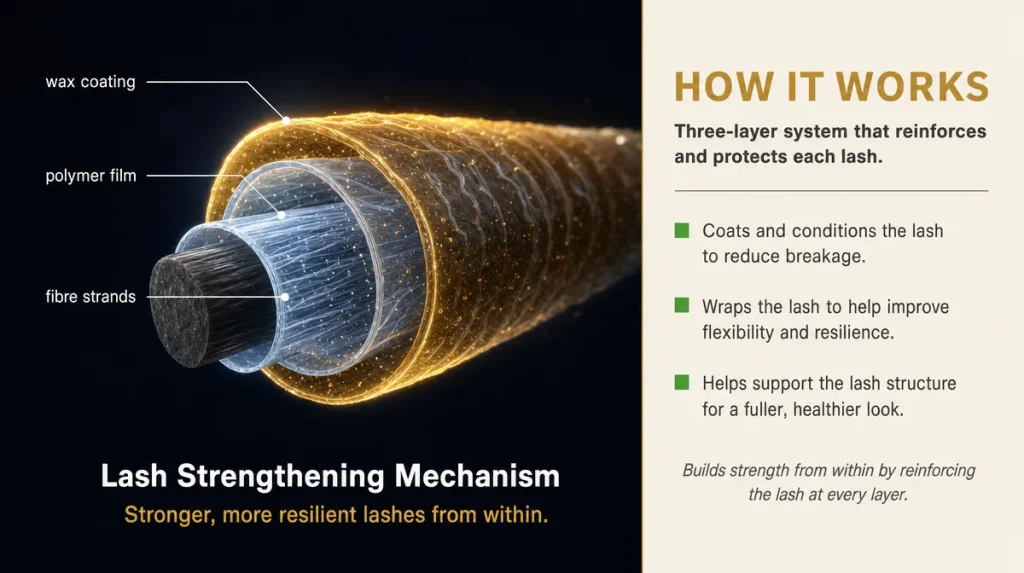
Think of a single lash hair the way you would think of a thin fence post left bare to the weather. Paint it once and it looks the same width, just darker. Paint it three or four times, letting each coat set, and the post visibly thickens: that is roughly what a volumizing mascara does to a lash, using waxes such as beeswax or carnauba and film-forming polymers instead of paint.
The waxes coat and stiffen the hair, holding a curl and giving the brush something to grip on the next pass. The polymers dry into a flexible film that binds that wax layer to the lash without cracking when you blink. Some formulas add microfibres, tiny rayon or nylon threads a fraction of a millimetre long, which cling to the wet coating and sit along the lash to bulk it out further, an approach discussed in formulation terms at International Federation of Societies of Cosmetic Chemists congress papers on lash cosmetics.
A 2023 study in the Journal of Cosmetic Science, testing panelists’ perceived lash thickness after repeated wear, found that formulas combining a wax base with a flexible polymer film scored consistently higher for visible density than wax alone, regardless of how the product was marketed on pack. The lesson is practical: it is the layering mechanism, not any single miracle ingredient, that does the work.
Reading The Ingredient List In Thirty Seconds
Ingredient lists on mascara are printed in International Nomenclature of Cosmetic Ingredients terms, which read like Latin to most shoppers. Cosmetics Europe, the Brussels-based trade association, publishes general consumer guidance on reading INCI lists, and its basic rule matches what any formulator will tell you: ingredients are listed in descending order of concentration, so the first five or six names carry most of the weight.
For a volumizing formula, look near the top of the list for a wax (words ending in a plant or animal source such as Cera Alba, Copernicia Cerifera or Candelilla Cera) and a film-forming agent, often listed as a polymer or acrylate. If you see “fiber” or “fibre” named directly, usually as nylon-12 or a similar synthetic, the formula is likely fibre-based rather than purely wax-based, which tends to give a more textured, bristly finish rather than a smooth, glossy one.
What you can mostly ignore, cost-wise: added vitamins, plant extracts and “conditioning complexes” listed near the bottom of the panel. They are present in amounts too small to change how the mascara performs, and their main job is the front-of-pack claim rather than the formula itself. This does not make them harmful, simply marginal to the volumizing effect you are paying for.
The Five-second Wand Test You Can Do In The Shop
Before you buy, and before you even look at the price, uncap the tester and turn the wand so the bristles face you directly, not sideways. Count roughly how many rows of bristles you can see along the visible length. A wand built for volume usually shows tightly packed, uneven bristle lengths, often described on pack as “hourglass” or “cone” shaped, so the wand naturally fans product outward as you sweep it.
Next, press the wand lightly against the back of your hand. A well-loaded, fresh mascara should deposit a visible line of product without dragging or leaving bald patches. If the tester feels dry, tacky or leaves clumps on first contact, that says more about how long the tester has been open in-store than about the formula itself, so do not judge a fresh tube by an old tester alone.
Finally, check the base of the bristles where they meet the wand shaft. Some volumizing brushes have a slightly wider base and taper towards the tip, which helps you load the lash root, where most visible density comes from, then draw fine coating out to the tips. A flat wand with uniform bristles from base to tip will struggle to do both jobs well.
Mistakes That Flatten Volume Before You’ve Left The Mirror
The single most common mistake is applying one thick coat and stopping. A heavy first pass overloads the lash with wet product, which then takes longer to dry and is more likely to clump as it does. Two or three thin coats, each given perhaps thirty seconds to set, build the layered film described earlier far more reliably than one generous swipe.
The second mistake is wiggling the wand only at the tips. Most of the visible density a lash can show comes from the root, closest to the lid, where the hair is thickest and most upright. Starting the stroke as close to the root as is comfortable, then drawing upward and slightly outward, uses the wand’s full bristle length rather than just its point.
The third mistake is pumping the wand in and out of the tube between coats. This pushes air into the tube, which dries the formula out faster and can introduce the exact tackiness that ruins a tester in a shop. Twisting the wand gently as you withdraw it, without pumping, keeps the formula usable for longer and reduces clumping on application.
Lastly, many people apply mascara to lashes that still carry a trace of oil-based eye cream or primer. Wax and polymer coatings adhere poorly to an oily surface, which is one reason the same mascara can perform beautifully one day and disappointingly the next, with nothing wrong with the tube itself.
Judging Results Honestly, Week By Week
A volumizing mascara should show its effect the moment you apply it: this is a cosmetic coating, not a treatment that builds over months. If a formula visibly thickens lashes on day one, that is the result, and it will look the same on day thirty provided the tube itself has not dried out.
Where genuine change over weeks does happen is at the lash line itself, not the mascara. Lashes shed and regrow on a natural cycle of roughly two to three months, according to general guidance published by the European Academy of Dermatology and Venereology, and how you remove make-up daily affects how many lashes you keep through that cycle rather than how thick any single lash looks under mascara.
So the honest way to judge a formula is short: apply it, check the density immediately under normal daylight, not shop lighting, and check again at the end of the day for flaking or smudging under the eye. If it holds its shape through a full day without transferring, and the density you saw in the mirror that morning is what you still see at 18:00, the formula is doing its job. Judging a mascara by whether your lashes seem thicker after a month of use is judging the wrong variable: that change, if it happens, belongs to your lash cycle and your removal habits, not the tube.
Marketing Words That Mean Something, And The Ones That Don’t
“Buildable” is a meaningful claim: it tells you the formula is designed to be layered without clumping on the second or third coat, which matters if you want strong volume. You can test it yourself with the tester, applying two coats thirty seconds apart and checking for clumping.
“Clinically tested” is close to meaningless on its own. It usually means a panel of a few dozen people used the product and answered a satisfaction survey, which is standard practice and not proof of superior performance. Ask instead, if the packaging offers a number, how large the panel was and over what period, details that a credible claim will usually state.
“Volumising fibres” is worth checking against the ingredient list rather than trusting on faith: if nylon or a similar fibre genuinely appears near the top of the INCI list, the claim is substantiated. If it appears far down the list, the fibre content is likely too low to change the result meaningfully.
“Dermatologist developed” tells you a dermatologist was involved somewhere in formulation or safety review, which is a reasonable safety signal but not a performance guarantee. Pan-European testing groups such as Euroconsumers, which runs the lab programme behind Test Achats, Altroconsumo, OCU and DECO Proteste, and the London-based consortium International Consumer Research and Testing, which coordinates joint lab work for testers including Which?, periodically publish comparative mascara results based on panel wear tests rather than marketing copy, and are worth checking if you want a second opinion beyond the shelf.
Removing Volumizing Mascara Without Stripping Your Lashes
The wax and polymer film that gave you volume all day is, by design, water resistant, which is exactly why it needs a proper solvent to come off rather than a splash of water and a flannel. Bilayer, oil-based or micellar removers break down that film far more gently than rubbing, which pulls at the lash shaft and can loosen hairs that were not ready to shed.
Soak a cotton pad, hold it against closed lashes for a slow count of ten, then wipe downward once rather than scrubbing back and forth. If mascara still clings at the roots, a fresh pad and a second gentle pass work better than pressing harder with the first one. Waterproof volumizing formulas, built with a heavier wax load precisely to resist humidity and tears, generally need an oil-based remover; water-based formulas usually come away with a micellar solution alone.
General guidance from the European Academy of Dermatology and Venereology on eye-area care recommends avoiding sleeping in eye make-up, since a coating left overnight can flake into the eye and cause irritation, and notes that gentle, complete removal matters more for lash health over time than any single mascara formula. Whichever remover you reach for, from a pharmacy shelf or a beauty retailer, that final full removal is doing more for how your lashes look next week than the mascara itself.
Key Takeaways
Volume is built through layered wax, polymer film and sometimes fibre, not through any single miracle ingredient, so judge a formula on how it layers rather than on its front-of-pack claim.
The wand shape controls how product reaches the lash root, where most visible density comes from, so a tightly packed, tapered brush usually outperforms a slim, even one for volume specifically.
A mascara that flakes or clumps is very often a storage and age issue rather than a technique failure: most tubes are past their best within three to six months of daily use.
Genuine change in lash appearance over weeks belongs to your natural lash cycle and your removal habits, not to the mascara, so judge a formula’s performance within a single day of wear, not over a month.
A Five-minute Checklist For The Aisle
- Uncap the tester and check bristle density and taper before reading any claim on the box
- Look for a wax and a film-forming agent near the top of the ingredient list
- Test two thin coats on the back of your hand, thirty seconds apart, for clumping
- Apply from the lash root outward, twisting rather than pumping the wand between coats
- Check density in daylight the same morning, not after weeks of use
- Match your remover to the formula: oil-based for waterproof, micellar for water-based
- Replace the tube within three to six months of first opening, regardless of how full it looks
This article is general information and does not replace personalised advice from a dermatologist or pharmacist.
Individual results with any mascara formula will vary depending on lash type, application and removal habits.