
Henrik Voss, Senior Health and Science Editor.
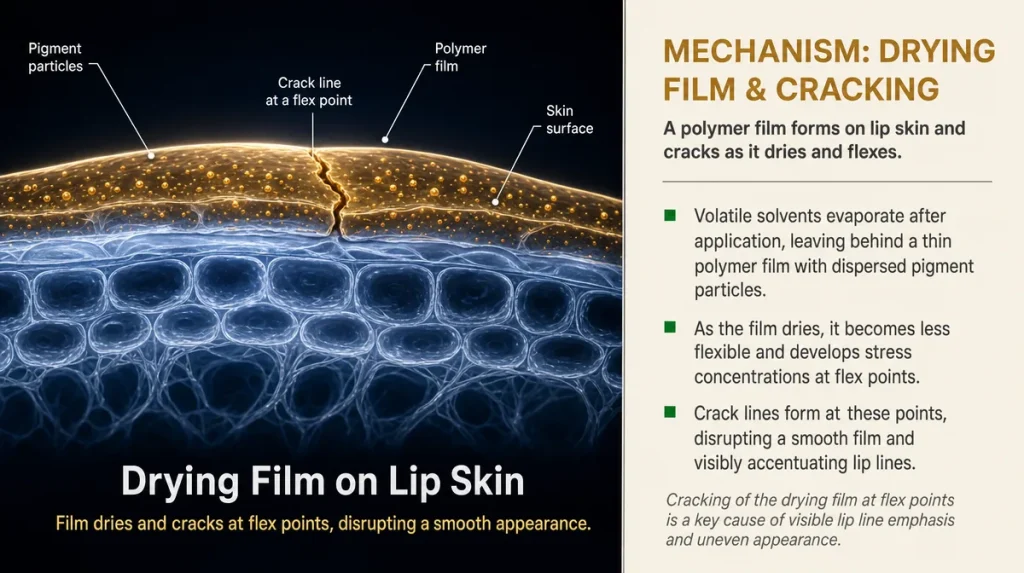
You catch sight of yourself in a shop window at half past two and the colour that looked so precise at eight that morning has thinned to a stain, patchy at the centre, gone entirely from the inner corners where a coffee cup met your mouth twice. The drawer at home has three near-identical tubes of long-wear liquid lipstick in it, each abandoned after a week for the same reason. The question typed into a search bar late at night is usually some version of why does this keep happening, and the honest answer has less to do with the lipstick itself than with the handful of small habits around it. One fact worth knowing before anything else: a long-wear formula does not fade because the pigment wears off. It fades because a thin plastic-like film cracks, and colour escapes through the cracks. Understand that, and most of the mistakes below start to make sense.
- Thin layers outlast thick ones: a heavy first coat cracks faster than two patient, thin ones, because the film cures unevenly.
- Prep matters more than the product: flaky or over-balmed lips break the film before it has a chance to set.
- Removal technique decides how your lips look tomorrow: pulling at a set film with a dry pad does more damage than the lipstick ever will.
Why The Colour Vanishes By Lunchtime
Most long-wear liquid lipsticks work by suspending pigment in a fast-drying carrier, usually built around film-forming polymers and volatile silicones. As the carrier evaporates, it leaves behind a thin, semi-rigid film that grips the outer layer of the lip skin. The pigment is not, strictly, glued to your lips. It is trapped inside that film.
Think of it the way a coat of varnish behaves on a wooden chair arm. Flat and undisturbed, it holds for months. At the joints, where the wood flexes every time someone leans on it, the varnish is the first thing to crack. Lips move constantly, to speak, to eat, to smile, and the film cracks along exactly those flex lines first, usually the centre of the lower lip and the corners of the mouth.
This is why colour often disappears from the middle before the edges: it is not being eaten away evenly, it is failing at the points of most movement. A 2021 study in the Journal of Cosmetic Science measured wear patterns on film-forming lip colour and found the greatest pigment loss occurred at flex points within the first two hours, independent of the amount of product initially applied.
The practical mistake that follows from this is applying more product to compensate. A thicker film is not a stronger one. It is simply a thicker layer of the same brittle material, and thick films crack sooner, not later, because they cannot flex with the skin beneath them.
Prepping Lips Without Overdoing It
A film sets more evenly over a smooth surface than a flaky one. Where dead skin lifts even slightly, the drying film has to bridge a gap, and that bridge is where it tends to crack first, sometimes within minutes of application.
The method that actually helps is modest: a damp flannel worked gently over the lips once or twice a week, or a balm with a fine sugar or jojoba-bead texture, used the same way. This is enough to lift loose flakes without disturbing the skin underneath.
The mistake nearly everyone makes is treating this like a daily step, using a gritty lip scrub every morning because it feels like good preparation. Dermatological guidance from the European Academy of Dermatology and Venereology on lip skin care notes that the lip has a thinner outer layer than facial skin and lacks the oil glands that help the rest of the face recover from mechanical exfoliation. Daily scrubbing here tends to create the very micro-roughness it is meant to remove, which then shows through the very finish you are trying to protect.
A simple self-test: run a fingertip lightly across your lips before you apply anything. If you can feel distinct rough patches rather than an even texture, exfoliate first and wait a few minutes. If the surface already feels even, skip the step entirely that day.
The Line Between Hydrated Lips And A Film That Will Not Stick
Long-wear formulas rely on quick evaporation to set. A heavy balm or oil applied directly underneath interferes with that process, because the film has an oily layer to bind to instead of skin, and it never fully cures. The result is patchy wear that looks fine for the first ten minutes and then slides unevenly within the hour, often worse than if no balm had been used at all.
The fix is sequencing, not avoidance. Moisturise lips generously earlier in the routine, ideally a few minutes before applying colour, then blot gently with a tissue immediately before the lipstick goes on. This removes the surface oil while leaving the deeper hydration intact.
A quick self-test worth doing at home: press a clean tissue flat against your lips right before applying colour. If it comes away with a visible greasy print, wait another minute or two before starting. If the print is faint or dry, you are ready.
Cosmetics Europe’s general guidance on lip product usage notes that wear-time claims are typically established under standardised laboratory conditions rather than the varied real-world combination of balms, weather and eating that most people actually apply products under, which is one reason the same lipstick can behave differently on the same person from one day to the next.
Applying In Thin, Patient Layers
The application method that gives the best result is unglamorous: one thin, even coat, a pause of around sixty seconds while it sets, then a second thin coat only where more opacity is genuinely needed, usually the centre of the lips.
The mistake most people make here is impatience. A first coat often looks patchy or streaky for the first thirty seconds, simply because the film has not finished drying, and it is tempting to go straight back in with more product to fix it. Doing this smears the half-set first layer rather than adding to it, which is exactly the patchy, uneven finish the second coat was meant to correct.
Working from the centre of the lips outward, rather than starting at the cupid’s bow and dragging colour all the way to the corners in one stroke, also helps distribute the product more evenly, since the centre area takes the most friction and benefits from marginally more coverage.
A short practical test: after your first coat, wait a full minute before deciding whether a second is needed. Most patchiness resolves on its own once the film finishes setting.
The Touch-up Trap
Once the film has cured, most long-wear formulas cannot simply be topped up. Fresh liquid product applied over an already-set film does not blend into it, it sits on top, and the two layers dry at different rates, producing a gummy, uneven texture that often looks worse than the faded colour it was meant to fix.
The mistake is doing this within the first few minutes after application, usually while blotting excess with a tissue because the finish still looks slightly wet. That wet appearance is often just the final stage of the film curing, not a sign of a failed application. Blotting or touching the lips at this stage lifts pigment before it has fully bonded.
A more reliable approach is to leave the film alone entirely for the first five minutes after application, resisting the urge to press lips together, sip a drink or check it in a mirror repeatedly. If a touch-up is genuinely needed later in the day, the more durable method is to remove the remaining product from that section first with a damp cotton bud, then reapply a thin fresh layer, rather than layering on top of what is left.
Removing Without Stripping The Lips
The same film that resists coffee and lunch also resists a dry cotton pad. Tugging at a set polymer film with dry friction pulls at the thin skin beneath it, and lip skin has none of the oil glands that help the rest of the face tolerate that kind of mechanical stress.
Oil dissolves the film chemically rather than pulling it away physically, which is why an oil-based remover or balm works more gently than soap and water or a dry wipe. The method is simple: press a cotton pad soaked in an oil-based remover against closed lips for ten to fifteen seconds, then wipe outward rather than scrubbing back and forth.
The common mistake is impatience again, scrubbing immediately because the colour has not lifted after the first swipe. Give the oil time to work before applying any pressure. Lips that are consistently stripped rather than dissolved tend to show finer dry lines and flake more within a day or two, a pattern noted in dermatological guidance on lip skin fragility, since repeated mechanical removal disrupts a barrier that has little natural reinforcement to begin with.
A useful habit: keep a dedicated oil-based remover or balm specifically for lip colour, separate from a general face cleanser, since face products are not always formulated to dissolve polymer film efficiently.
Reading The Label Without Falling For The Marketing
Terms like extended wear or all-day colour describe conditions tested under controlled laboratory settings, generally without eating, drinking or repeated lip contact, according to Cosmetics Europe’s general guidance on cosmetic product claims. Real days involve all three, often within the first hour, so a formula’s actual performance on you will usually fall short of the number implied on the packaging, and that gap is normal rather than a sign the product has failed.
What matters more than the wear-time claim is the ingredient category near the top of the list. Formulas built primarily around film-forming polymers and silicones tend to resist transfer better but can feel drying over many hours. Formulas leaning more on waxes and emollients feel more comfortable but transfer more easily onto glasses and masks. Neither is objectively better, they suit different days and different mouths.
A quick way to judge a formula honestly, rather than by its box copy, is a two-hour test at home before a big day: apply as usual, then eat something oily and drink a hot drink, and check how the colour holds at the flex points discussed earlier. That single test tells you more about real-world performance than any claim on the packaging.
Storage Mistakes That Ruin A Good Lipstick Early
Long-wear liquid lipstick formulas are, chemically, mostly volatile solvents holding pigment and polymer in suspension. Heat accelerates evaporation, and a bathroom cabinet that regularly reaches high temperatures during showers, or a car left in summer sun, dries the formula out from the inside of the tube long before the stated shelf life.
The visible sign is a texture change: the product turns stringy, drags rather than glides, or separates slightly when the wand is pulled out. Once this happens, no amount of shaking restores the original consistency, because the balance of solvent to solid content has permanently shifted.
Most tubes carry a small open-jar symbol on the packaging indicating the recommended period of use after opening, commonly somewhere between six and twelve months for this category. The common mistake is ignoring that entirely and keeping a favourite shade for years, particularly ones used only occasionally for special occasions.
Storing the tube upright, at room temperature, away from direct sun or a radiator, is the simplest way to extend its usable life. If the wand starts to feel gummy or the colour pulls unevenly despite good application technique, that is a sign to replace it rather than a technique problem to solve.
Key Takeaways
Long-wear liquid lipstick fails predictably, not randomly, and nearly every common complaint traces back to one of a small number of habits.
Thin layers, applied patiently, outlast thick ones because the film cures more evenly and flexes better. Preparation matters more than most people assume, but gentle and occasional beats frequent and harsh. Sequencing balm before colour, rather than skipping it or layering it directly underneath, avoids the patchy slide that heavy oils cause. Leaving the film alone for the first few minutes protects the finish far better than an early touch-up. And removal deserves as much thought as application: oil dissolves what a dry pad only tears at.
A Quick Checklist Before You Apply
- Exfoliate lightly, once or twice a week, never daily
- Moisturise early, then blot any excess oil immediately before colour
- Apply one thin coat, wait a minute, add a second only where needed
- Leave the finish undisturbed for the first five minutes
- Test wear with food and a hot drink before a long day out
- Remove with an oil-based product, pressed and held, never scrubbed
- Replace the tube if the texture turns stringy or drags, regardless of age
This article is general information and does not replace individual advice from a dermatologist or pharmacist.
Results and wear time vary by lip type, climate and daily habits.