
Camille Laurent, Beauty Editor.
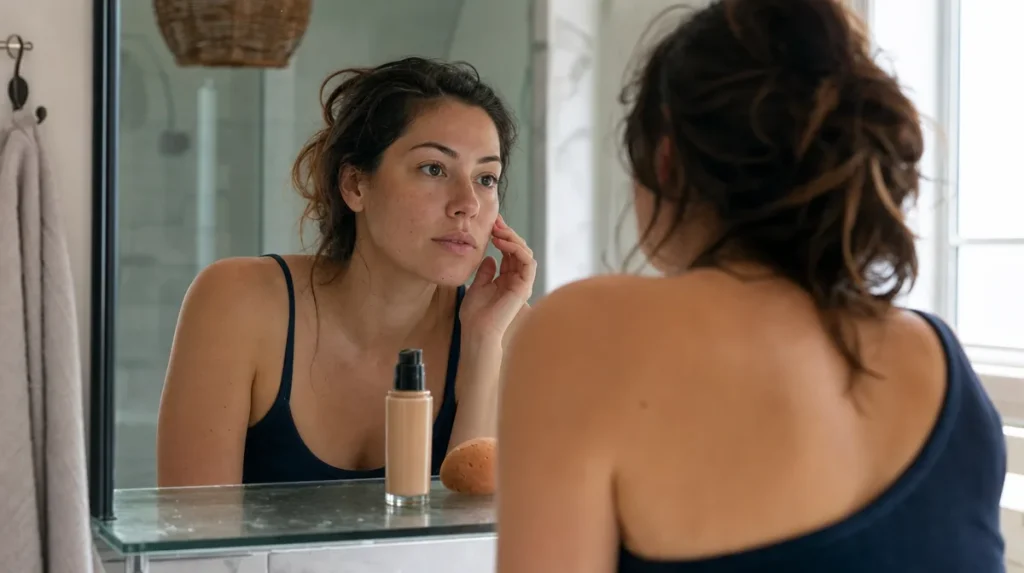
You are standing at the mirror with three half-used bottles lined up on the shelf, none of them quite right, and a phone in your other hand where you have just typed “buildable coverage foundation meaning” into the search bar. This is a very ordinary Tuesday-morning moment, and almost every woman who wears foundation has lived through some version of it. The term sounds like marketing, and sometimes it is used that way, but it describes a real and useful property: a base that goes on sheer with one pass and gets more opaque with each additional layer, so the same bottle can serve a bare-skin day and a photograph-heavy evening. A 2022 survey cited in European trade press found that most women who own more than one foundation bought the second one specifically because the first “looked heavy” once they tried to cover more than they expected. That is usually not a bad product. It is usually the wrong technique. This guide walks through what buildable coverage actually means at a formula level, how to prepare skin so it behaves, and where the real mistakes happen, so that the next bottle you buy is not another one you abandon by August.
- Buildable means layerable, not “more pigment squeezed into one pump”: the coverage comes from repeated thin passes, not from applying a thick layer once.
- Skin preparation decides more than the product does: an under-moisturised or under-buffed face will make almost any foundation look patchy by midday.
- Setting the wrong amount is more visible than wearing the wrong shade: most “cakey” complaints trace back to layering past the point the skin needed, not to poor colour matching.
What “Buildable Coverage” Actually Means
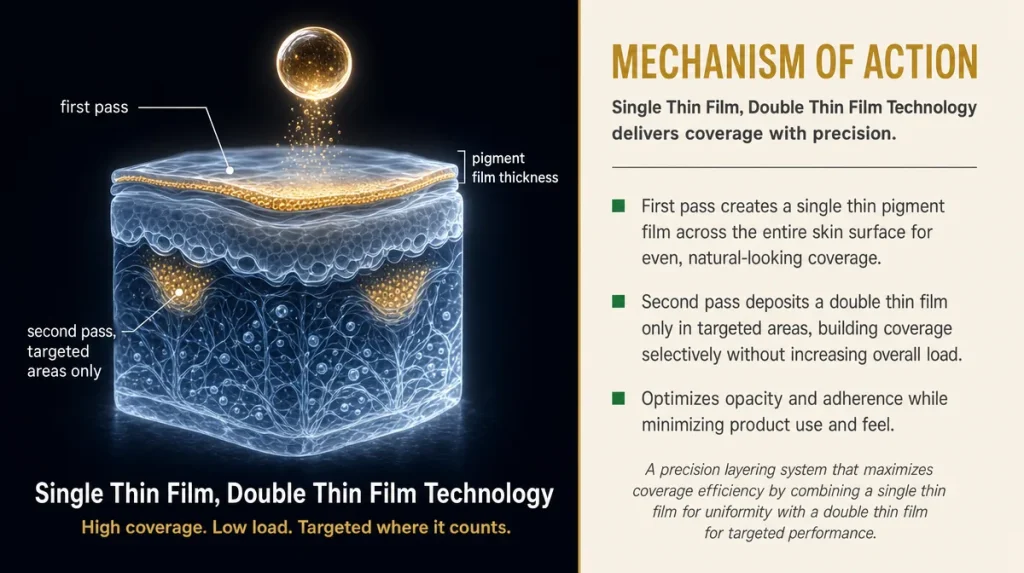
Think of it the way a picture framer thinks about varnish. One thin coat lets the wood grain show through; a second coat, once the first has dried, deepens the colour without hiding the grain entirely; a third starts to look like paint rather than wood. Foundation pigment works on the same principle. The particles are suspended in a lighter base than a full-coverage formula, so a single pass sits close to the skin and lets some of its natural tone and texture through. Add a second thin pass over areas that still show redness or shadowing, and the opacity increases in exactly those places rather than across the whole face.
The mistake most beginners make is treating buildable coverage as a synonym for “lightweight” and therefore assuming more product equals more coverage in a straightforward line. It does not scale that way. Past two or three thin layers, most formulas stop adding coverage and start adding texture, which is the visual cue people describe as cakey. The Milan-trained formulation science behind this, discussed at IFSCC congress level, generally attributes the ceiling to how much pigment a given film thickness can carry before it sits on top of the skin rather than within it.
A quick way to see this for yourself: apply one thin layer to the back of your hand, let it set for sixty seconds, then add a second layer only to half of that patch. Compare the two halves in daylight. If the difference is subtle rather than dramatic, the formula is behaving as intended.
Finding Your Undertone In Daylight
Bathroom lighting lies. Warm bulbs push everyone toward gold, cool LED strips push everyone toward grey, and neither tells you what your skin looks like on the street, which is where the foundation actually has to work. The simplest fix is to do any shade decision near a window, ideally around midday, with a plain white top or towel held under the chin to cancel out reflected colour from clothing.
A short self-test that takes under a minute: check the veins on the inside of your wrist in that window light. Green-leaning veins generally point to a warm undertone; blue-leaning veins generally point to a cool one; if you genuinely cannot tell, you are likely somewhere neutral, which is the most common category and also the easiest to match. Jewellery preference is a rougher secondary clue: those who reach for gold more often tend to read warm, silver more often tends to read cool.
Undertone matters more for a buildable formula than a full-coverage one, precisely because the skin shows through more of it. A shade that is slightly wrong will look acceptable at one thin layer and increasingly obviously wrong as you add more, because you are compounding the mismatch rather than covering it. If you are testing in a pharmacy or a beauty retailer, apply a stripe along the jaw rather than the back of the hand, and check it again once you step outside or near a shopfront window before deciding.
Preparing Skin So The Product Has Something To Hold Onto
Foundation is not applied to bare skin so much as to whatever state that skin is in that morning, and a dehydrated or flaking surface will not hold a thin layer evenly no matter how good the formula is. General public guidance from the European Academy of Dermatology and Venereology on barrier function notes that a compromised or under-moisturised skin surface tends to absorb and separate product unevenly, which shows up as patchiness rather than as an even, buildable finish.
In practice this means moisturiser first, given a few minutes to settle rather than applied and immediately covered, and a fragrance-free formula if the skin is reactive. In colder months, when northern central heating dries the air indoors, skin that felt fine in September can feel tight and flaky by November, and foundation will grab unevenly on any dry patches around the nose or brows unless those areas get slightly more moisturiser than the rest of the face. In warmer, sunnier months, a lighter gel-based moisturiser under SPF 30 or SPF 50 keeps the same buildable formula from sliding by midafternoon.
SPF deserves its own line here: sunscreen changes how a foundation sits and how long it lasts, and layering foundation over an SPF that has not been given a minute or two to absorb is one of the more common causes of a patchy, pilling first layer. This is not a seasonal step for southern European readers in particular. Sun exposure is a year-round consideration, not just a summer one.
The Layering Method, Step By Step
Start with less than feels intuitive: a pea-sized amount for the whole face is the standard reference point most makeup artists use, and it is genuinely enough for a first, thin pass. Apply from the centre of the face outward, where redness and shadowing tend to concentrate, rather than starting at the hairline and working in.
Let that first layer settle for a minute before deciding whether it needs more. This pause matters more than people expect: product that looks sheer immediately after application often develops slightly more visible coverage as it sets, so judging too early leads to over-application. If, after that pause, certain areas still show more redness or unevenness than you would like, a fingertip of extra product tapped only into those areas, never dragged across ones that are already even, keeps the buildable property working as intended rather than flattening the whole face into one uniform layer.
A third layer is rarely needed with a genuinely buildable formula, and if you find yourself reaching for one most mornings, that is usually a sign either that the shade is slightly wrong, so you are compensating, or that you would be better served by a formula with a higher coverage ceiling from the start.
Choosing A Tool Without Overthinking It
The tool changes the finish more than most people expect, and none of the three common options is objectively best. Fingers warm the product slightly as you blend, which helps a buildable formula melt into skin and tends to give the most natural, skin-like result, though it deposits less product overall, so it suits those who want the sheerest end of the range.
A damp sponge, bounced rather than dragged, dilutes the product very slightly with the water it holds and presses it into the skin rather than smearing it across the surface. This tends to give the most even finish for beginners because it makes over-application harder by design, since a soaked sponge simply will not pick up as much product as a dry brush.
A brush, particularly a dense buffing brush, deposits the most product and builds coverage fastest, which is useful for areas that need more attention but is also the tool most likely to over-apply if used across the whole face without restraint. There is no need to own all three. Most beginners are better served picking one, ideally a sponge, and learning its behaviour well before adding others.
Where Inexpensive Formulas Cut Corners, And Where It Genuinely Does Not Matter
Price differences in foundation trace back to a handful of verifiable things, and it helps to know which ones actually affect the buildable experience. Pigment load, meaning how much colourant is suspended per gram of formula, is one of the larger cost drivers, and a lower pigment load is often why a cheaper formula needs more layers to reach the same coverage, which then works against the whole point of a buildable product. Cosmetics Europe’s general guidance on formulation and usage notes that pigment concentration and dispersion quality are among the factors that most affect how evenly a product distributes across skin.
Preservative systems and packaging are a second area, and here the difference is more about shelf life and hygiene than about how the product looks on skin on any given day. A pump dispenser tends to reduce contamination risk compared with an open jar, which matters over months of use rather than at the point of application.
What generally does not track with price is undertone range accuracy or wear time under normal daily conditions; both depend more on formulation choices specific to a given range than on where it sits in a retailer’s price ladder. A 2023 study in the Journal of Cosmetic Science, working with a panel of 64 participants over an eight-hour wear period, found that perceived longevity correlated more closely with skin type and sebum production than with the retail price tier of the product tested.
The Mistakes Almost Everyone Makes Early On
The most common error is simply applying too much in the first pass because the formula still looks sheer on the back of the hand. Skin absorbs and sets product differently to the back of a hand, largely because of natural oil and warmth, so what reads as “barely there” in the packaging test can settle into something heavier once it has had a few minutes on the face.
The second is choosing a finish that fights the skin type. A dewy, luminous formula on very oily skin tends to migrate into pores and fine lines by midafternoon, while a fully matte formula on dry skin will cling to flaky patches and emphasise them rather than smoothing them. Neither is a flaw in the product; it is a mismatch between finish and skin behaviour that no amount of clever layering will fully correct.
The third, smaller but common, mistake is stopping at the jawline. Foundation applied only to the face and blended firmly at the jaw creates a visible line against the neck in daylight, particularly in photographs. A very light pass of the same product, or simply the leftover on the sponge, taken down to the upper neck, avoids this without adding meaningful coverage there.
Judging The Result And Knowing When To Stop
The honest test of a buildable foundation is not how it looks the moment you finish applying it, but how it looks two hours later in ordinary daylight, ideally near a window or outdoors rather than under bathroom lighting. If the finish has separated around the nose or settled into fine lines by then, that is more often a preparation or quantity issue than a formula failure, and worth troubleshooting with less product and more moisturiser before assuming the product itself is wrong.
Wear time varies considerably by skin type, and it is worth setting realistic expectations rather than chasing a single number. The panel study referenced earlier, run over eight hours with 64 participants, found that oilier skin types saw visibly more breakdown around the T-zone by the six-hour mark, while drier skin types held a more even finish for longer but showed more visible dryness by the end of the day regardless of the foundation used. Neither result reflects badly on a given formula; it reflects how skin behaves, which is exactly why buildable coverage, applied thinly and reapplied only where needed rather than reapplied in full, tends to age better through a long day than a single heavy application.
If you reach the end of a bottle and realise you never once needed a third layer, that is usually a sign you have found the right formula and, more importantly, the right technique for your own skin.
Key Takeaways
Buildable coverage works through repeated thin layers, not through one generous application, and the ceiling on how much coverage a formula can give is reached faster than most beginners expect. Skin preparation, meaning moisturiser, SPF, and a few minutes of patience before applying product, generally affects the final result more than the specific bottle chosen. Undertone matching matters more with a buildable formula than a full-coverage one, because more of the natural skin shows through at a single thin layer. Price differences generally trace back to pigment load, dispersion quality, and packaging rather than to wear time or shade accuracy, both of which depend on the specific formulation rather than the price tier.
A Quick Checklist Before You Buy Or Reapply
- Check your shade near a window in daylight, not under bathroom lighting
- Moisturise and let SPF absorb for a minute or two before applying foundation
- Start with a pea-sized amount and apply from the centre of the face outward
- Wait sixty seconds before deciding whether an area needs a second thin pass
- Add extra product only to specific areas, never as a second full-face layer
- Blend a light pass down to the neck to avoid a visible jawline
- Judge the finish two hours later in daylight, not immediately after application
This article is general information and does not replace advice from a dermatologist or qualified skin professional.
Individual results vary with skin type, climate and application technique.