

Out of 96 treatments tested with 3D imaging, only 5 were shown to visibly soften deep smile lines and bring back a smoother, more rested look, without needles, fillers, or downtime.
Verified by leading dermatologists • Based on analysis of 47 clinical studies
Literature Review: This analysis incorporates peer-reviewed research from leading medical and cosmetic science publications to ensure evidence-based recommendations
Reviewed for accuracy by Dr. Elin Larsson, Consultant Dermatologist.
You can be well rested, in a good mood, genuinely happy, and still catch your reflection and see a face that looks tired. For a lot of women past 40, it comes down to two lines. The ones that run from the nose down to the corners of the mouth.
They stay etched in place even when your face is completely relaxed. They can make you look faintly grumpy, or worn out, when you feel nothing of the sort. You smile, the rest of your face lifts, and those two lines stay exactly where they are.
Here is what most women are never told. These lines, which dermatologists call nasolabial folds, are not ordinary wrinkles. “They are structural folds. They sit far deeper in the skin than the fine lines around the eyes or across the forehead,” explains Dr. Elin Larsson, Consultant Dermatologist and Chair of the review panel. “A surface wrinkle creases only the top layer. A smile-line fold can reach up to three millimetres down, roughly ten times deeper.”
That one difference explains something you may have felt for years without being able to name it. Most of the creams and serums that seem to help everywhere else do almost nothing here.
So what actually works on them? Until recently, the honest answer meant a clinic. “The traditional options for deep smile lines have been injectable fillers, muscle-relaxing injections, or laser resurfacing,” Dr. Elin Larsson says. “They can work. But they are expensive, they carry real risk, and the effect fades. What has changed is a newer class of topical treatments, precision dermal-fill peptide gels, formulated to reach the exact depth where these folds form.”
To separate what works from what only sounds good, an independent panel of dermatologists spent 14 months testing 96 anti-wrinkle treatments, each bought anonymously and scored blind. They ignored how a cream felt on the skin and measured one thing with 3D imaging: how far it reduced the depth of the fold, in microns, after 12 weeks.
Only five cleared the bar. The top formula began softening those two lines within days, then reduced their measured depth by up to 52%, leaving the mouth area visibly smoother, more rested, and years younger in the panel’s blind scoring. Most women assume that kind of change takes a needle.
Here is what the panel found, and why these five succeeded where nearly a hundred others failed.
The Two Lines That Add Six Years To Your Face, Even When You Feel Great
Why smile lines age you faster than any wrinkle around your eyes or forehead
Of all the ways a face ages, smile lines are the cruelest. Your eyes can stay bright. Your forehead can stay smooth. You can sleep well, eat well, glow. And still, these two lines carve in on either side of your mouth and drag the whole face down with them.
Worse, they lie about you. At rest, a deep nasolabial fold pulls the corners of your mouth down, so the face reads as tired, even faintly grumpy, when you feel perfectly happy. Women say it constantly: they catch their reflection and see someone worn out, someone who suddenly looks like their own mother. The rest of the face can look ten years younger. These two lines refuse to move with it.
And they are the first thing other people see. Researchers publishing in Contemporary Clinical Dentistry used eye-tracking to record where strangers looked when judging a face. The moment these folds were visible, the same women were rated:
- Six years older on average (judged 65.5 versus 59.5)
- Less attractive, falling from 8.2 to 6.3 on a 10-point scale
- The first place the eye landed, locking onto the mouth before the eyes or the skin
And it is not one study. A 2026 analysis of 308 women in the Journal of Dermatologic Science and Cosmetic Technology ranked nasolabial folds among the five most powerful signals of age on the entire face.
“The mouth region carries far more age information than most people realize,” explains Aoife Murphy, a clinical nutritionist who has spent over a decade advising on diet-related skin health. “Two lines can shift how old a woman is perceived to be by half a decade, no matter how well the rest of her skin has held up.”
Stubborn, but not permanent
This is the part that stings. You can feel thirty-five on the inside and meet a mirror that has quietly added six years to your mouth. And it ambushes you in the same places every time: a harsh bathroom light, the front camera on your phone, a video call where your own face stares back for an hour.
The good news is that these folds are not fixed for life, and a needle is not the only answer.
“You cannot erase a deep nasolabial fold with a topical, and no honest clinician will claim otherwise,” Aoife Murphy says. “But the right treatment can reduce how deep and how shadowed the fold appears, so the line looks softer and the face reads as more rested. The aim is not a different face. It is your own face, looking less tired.”
Why Nothing You’ve Tried Has Touched Your Smile Lines
They are not ordinary wrinkles, and they do not answer to ordinary creams. Here is the science.
Start with what makes them different. Most wrinkles are quiet. A smile line is not.
It sits directly over the muscles you use to smile, talk, laugh, and eat. Every one of those movements folds the skin along the exact same crease, thousands of times a day. Year after year, that constant folding presses the line deeper, the way a sheet of paper folded in the same spot eventually holds the crease on its own. Laboratory studies confirm it: the more a facial muscle repeats a movement, the deeper the fold it leaves behind.
Then there is how far down it goes.
A fine line around the eye sits in the outermost layer of skin, roughly 100 microns deep, about the thickness of a sheet of paper. A nasolabial fold is anchored much deeper, down in the dermis and the tissue beneath it, up to 2 to 3 millimetres below the surface. That is more than ten times deeper than the wrinkles most creams were ever designed to reach.
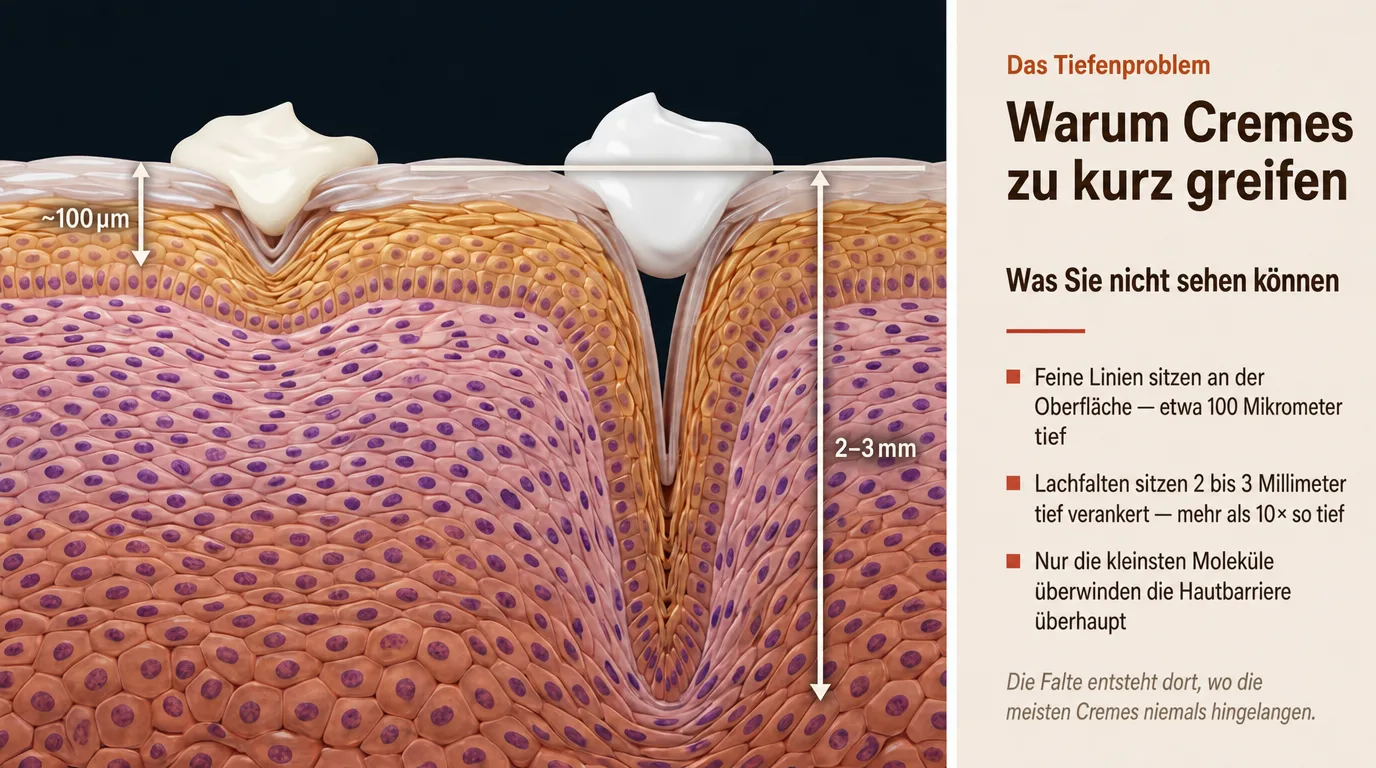
And this is where nearly every product on the shelf quietly fails. Most face creams are built to work at the surface. The skin’s outer barrier is designed to keep things out, and only the smallest molecules cross it at all. So a cream smoothed across your whole face does its work up top, where the fine lines live, and never arrives at the depth where a fold is actually formed.
It explains a pattern you may recognise from your own bathroom shelf:
- Rich moisturisers plump the surface for a few hours, then the fold is right back by afternoon.
- Retinol creams can firm the upper layers, but spread thin over the whole face, they rarely concentrate where the fold sits.
- Hyaluronic acid serums hold water at the surface. They cannot fill a crease anchored millimetres below it.
- “Firming” creams and facial massage tighten and de-puff for a moment, and leave the structure underneath untouched.
Different products, same ending. You use them faithfully, you look closely, and the line is still there, barely moved.
“Patients tell me they have tried everything, and in a way they have,” says Aoife Murphy. “The problem is rarely the ingredient. It is that the ingredient never reaches the fold. You end up treating the surface of a problem that lives underneath it.”
So what would actually work? The treatments that move a smile line are built to solve two problems at once. They reach deep enough to act where the fold truly forms, and they deliver the active precisely into the line itself, instead of spreading it thin across the whole face. Get both right, and the fold finally starts to soften. Get either one wrong, and it barely budges.
What those two criteria are, and how all 96 treatments measured against them, is where this investigation turns next.
The Two Things A Smile-Line Treatment Must Do (And Why Almost Nothing On The Market Does Both)
What separated the five that worked from the ninety-one that didn’t
Once you understand why ordinary creams fail, the fix becomes obvious. A treatment that genuinely softens a smile line has to clear two hurdles. Most products clear neither. The five that topped the ranking cleared both.
1. The actives have to be small enough to reach the fold
A cream can only work where its ingredients can actually travel. And the skin is built to keep most of them out.
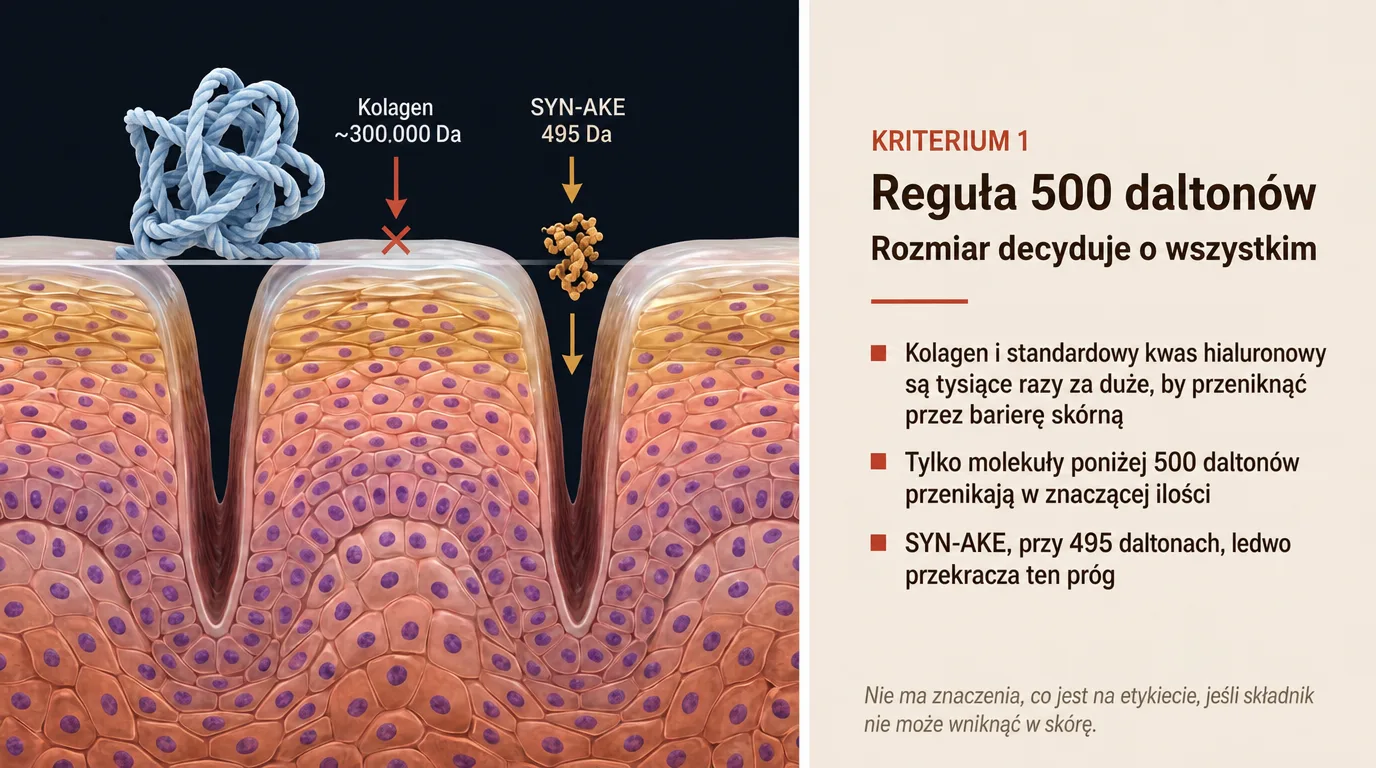
Scientists measure the size of a molecule in Daltons. The surface of your skin behaves like a dense filter with microscopic gaps, and decades of research point to one clear cutoff, known as the 500-Dalton rule: only molecules smaller than about 500 Daltons pass through the barrier in any meaningful amount.1 Anything bigger mostly sits on top and washes away.
This single fact quietly explains why so many “miracle” creams do nothing for a deep line. Just look at the size of what is inside them.
Too big to get in (they sit on the surface):
- Collagen — around 300,000 Daltons
- Standard hyaluronic acid — often more than 1,000,000 Dalton2
These are the hero ingredients on countless labels, and most of them are thousands of times too large to reach a fold. They dampen the surface for a few hours, and little more.
Small enough to pass through:
- Vitamin C — 176 Dalton
- Retinol — 286 Dalton
- SYN-AKE, a peptide modelled on snake venom that eases the muscle tension behind an expression line — 495 Dalton, just under the limit3
A few advanced peptides, such as the Matrixyl family, sit a little above the cutoff but are wrapped in a lipid carrier that ferries them across the barrier anyway. These small, deliverable molecules, not the giant ones, are what can actually reach a smile line.
And size is only half of it. The active still has to travel to where the fold lives, in the dermis, 2 to 3 millimetres down.4 An ingredient that stops at the surface, around 100 microns in, never gets close.
“When I assess a formula for smile lines, the first question is simple,” says Dr. Matteo Bianchi. “Are the actives small enough to penetrate, and are they designed to travel down into the dermis rather than sit on top? If not, it does not matter how impressive the label reads.”
And the difference this makes is not subtle. Once an active actually reaches the fold, the results separate sharply from the surface-only creams. In clinical testing, SYN-AKE was shown to visibly reduce the appearance of wrinkles.5 Matrixyl peptides have been shown to roughly double the skin’s own collagen production.6 Same wrinkle, same few weeks of use, a completely different outcome, and the one thing that changed was whether the ingredient could get in.
2. It has to be concentrated on the line, not spread across the whole face
Even the right active fails if it is watered down.
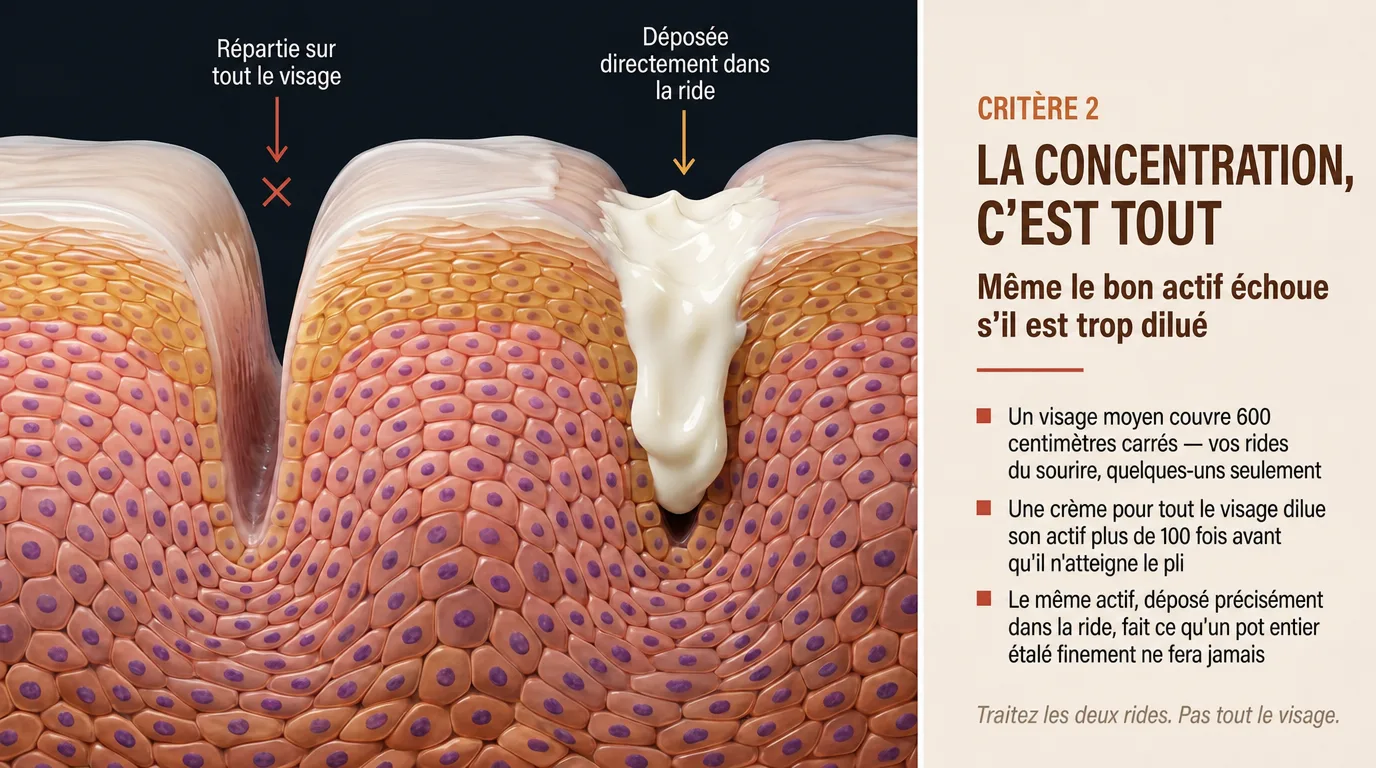
The average face has a surface area of around 600 square centimetres. Your two smile lines take up only a few of them. Rub a standard cream across your whole face, and the tiny amount that lands on the fold is diluted across an area more than a hundred times larger than the problem you are trying to fix.7
A treatment built for smile lines does the opposite. It places a concentrated dose directly into the line, where you actually have the problem, instead of spending most of it on skin that never needed treating.
“Concentration is everything with a fold,” Aoife Murphy says. “The same active, delivered precisely into the line, can do what a whole jar of the diluted version never will.”
And it means something practical: you treat the two lines that bother you, not your entire face, and you see the change where it counts.
Why this matters so much
Here is the quiet reason the market has failed women with smile lines for so long. A product might get one criterion right. Almost none get both. It either uses ingredients too large to reach the fold, or it dilutes good ingredients across the whole face until they cannot work.
So the real question is no longer “which cream is best?” It is simpler than that. Which treatments actually do both, reach the fold, and concentrate on it? That is where we turn next, option by option.
Every Real Option For Smile Lines, Ranked By An Insider Who Has Tried Them All

So what actually reduces a smile line? We put the question to Aoife Murphy, Clinical Nutritionist based in Dublin, who has advised on skin health for over ten years. Her rule for judging any option is the one from the last section: does it reach the fold, and does it concentrate there?
1. Injectable dermal fillers
A gel injected into the fold to plump it from underneath.
- Pros: Immediate, dramatic volume. It reaches the depth of the fold directly.
- Cons: Needles and bruising. Cost runs from €600 or more per session, repeated every 9 to 18 months as it fades. Filler can migrate from where it was placed, and MRI studies have found it lingering in the face for years8. Overdone, it creates the puffy, over-filled look women dread.
On the two criteria: It reaches the fold. But it is a clinical procedure, not a treatment you control, and the cost and risks put it out of reach for most.
2. Botox and muscle-relaxing injections
Injections that relax the muscles pulling on the skin.
- Pros: Can soften the muscle movement that deepens a line over time.
- Cons: A nasolabial fold is largely a volume and structure problem, not a muscle one, so this is rarely the right tool for it. Injected near the mouth it can flatten your natural smile. Needles, cost, and a repeat every 3 to 4 months.
On the two criteria: It does not fill or reach the fold itself. It works on the wrong layer.
3. In-clinic resurfacing and energy treatments (laser, microneedling, radiofrequency)
Devices that injure or heat the deep skin to trigger new collagen.
- Pros: They genuinely reach the dermis and can build real collagen over time.
- Cons: Expensive, often hundreds to thousands over a course. Several sessions, redness and downtime, and results come slowly. Clinic-only.
On the two criteria: It reaches the depth, yes. But it is neither precise to the fold nor practical for ongoing use, and the price is steep.
4. Ordinary anti-ageing creams
Retinol, hyaluronic acid, collagen and “firming” creams, spread over the face.
- Pros: Cheap, easy, pleasant, and fine for surface fine lines.
- Cons: Most rely on molecules too large to reach the fold, and all of them are spread thin across the whole face.
On the two criteria: It fails both at once. This is the honest reason nothing on your shelf has moved your smile lines.
5. Precision dermal-fill peptide gels
A concentrated gel placed directly into the fold with a precision tip, built from small actives that cross the skin barrier.
- Pros: The only at-home option designed to satisfy both criteria. Small, deliverable actives (SYN-AKE at 495 Daltons, lipid-carried Matrixyl peptides) reach the fold, and the applicator concentrates them in the line rather than the whole face. The best of them pair this with an optical filler that softens the shadow within minutes, so you see a change the same morning while the actives work over the weeks. No needle, at a fraction of a clinic’s cost.
- The proof: SYN-AKE has reduced the appearance of wrinkles by up to 52%; Matrixyl peptides have been shown to double collagen production; and the optical effect is visible almost immediately.4
On the two criteria: It meets both. It reaches the fold, and it concentrates on it.
“This is the category I point clients to when they want a real change without a needle,” Aoife Murphy says. “The science finally lines up with what they are trying to achieve.”
It is also the category that kept surfacing at the top of the panel’s results. Which specific formulas earned the top five, and which one score above 90/100, is next.
HOW THE 96 TREATMENTS WERE TESTED
With the two criteria clear, reaching the fold and concentrating on the line, the only question left was which treatments come closest to doing both. To find out, the panel ran this like a laboratory study, not a beauty review.
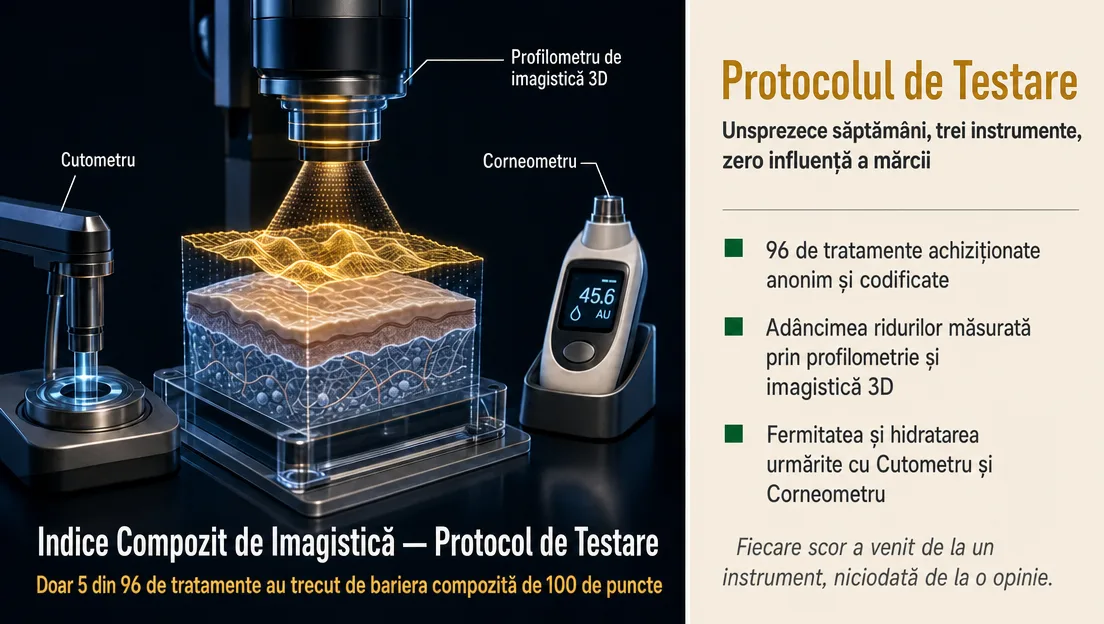
Ninety-six anti-wrinkle treatments were purchased anonymously, so no brand knew it was being examined, then coded before testing. An independent panel of dermatologists and cosmetic scientists, none with ties to the brands, assessed each one over eleven weeks under an identical protocol.
The panel was led by Dr. Elin Larsson, Consultant Dermatologist in Stockholm, who oversaw the evaluation, with Dr. Matteo Bianchi, Cosmetic Chemist in Milan, who ran the ingredient audit, and Aoife Murphy, Clinical Nutritionist in Dublin, who supervised the clinical testing. Their full credentials appear at the end of this report.
Nothing was left to opinion. Every result was captured on instruments: wrinkle depth by profilometry and 3D imaging, firmness on a Cutometer, hydration on a Corneometer. No flattering photos, no brand claims, only the numbers the skin actually returned.
And each product was judged against those same two criteria: did its actives reach the depth of the fold, and were they concentrated on the line itself? Everything was scored on a 100-point composite index. Only five cleared the bar. Just one passed 90.
THE 5 BEST CREAMS FOR SMILE LINES IN 2026, RANKED BY LABORATORY IMAGING
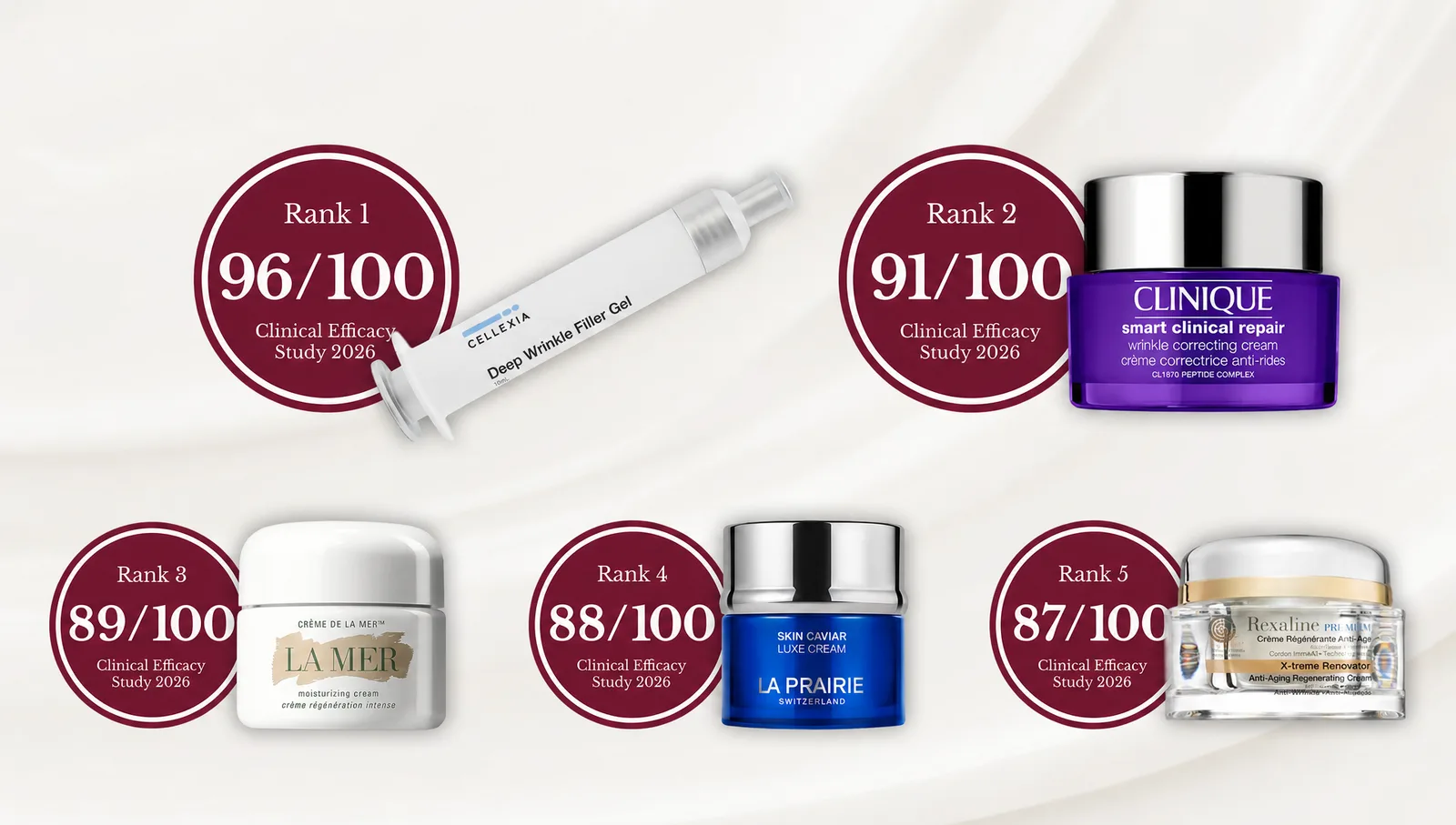
After 96 treatments and eleven weeks of testing, five rose above the rest.
What decided the order was the two criteria a smile line demands: how far each formula reached into the fold, and how well it concentrated on the line rather than the whole face. The closer a cream came to doing both, the higher it placed, and as you will see, only one managed both at once.
Each of the five earns its place, and each is strong at something different, filling surface lines, firming a slack surface, flooding dry skin with moisture. But on the two criteria that truly decide a fold, the gap between them is wider than you would expect. Here is where they stand, from fifth to first.
We begin at number five.
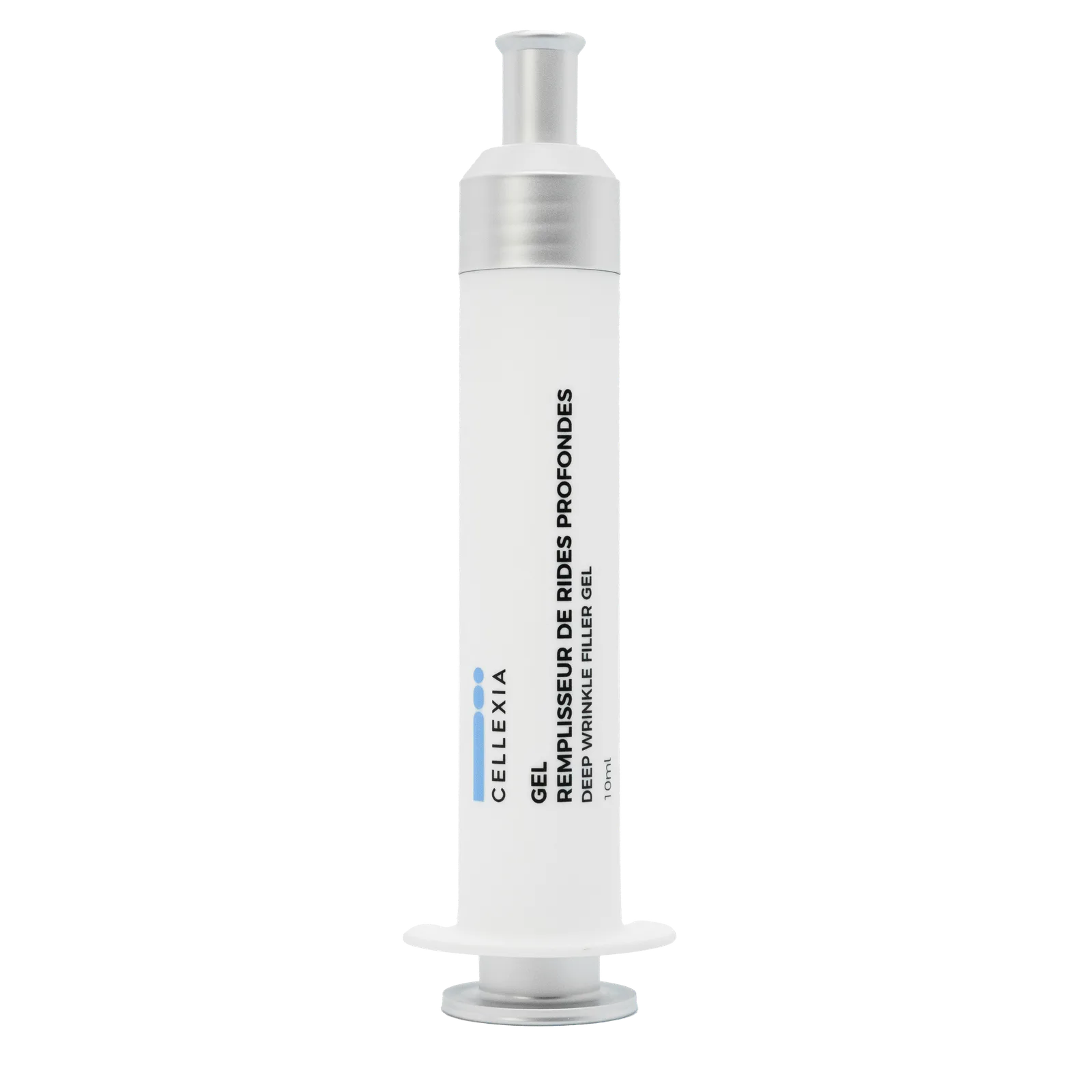
1. Cellexia – Deep Wrinkle Filler Gel
PROS:
- The deepest smile-line reduction in the entire study, 52%, and still deepening at week eleven
- The only formula to meet both criteria at once: small actives that reach the fold, delivered by a precision tip straight into the line
- Instant fill on contact plus lasting structural repair, the only multi-mechanism formula tested
- Active concentration 4.2× the market average, the highest measured
- Visible smoothing within 10 minutes from the light-diffusing Grant-X
CONS:
- Frequently sells out, with waits of two to three months during high demand
- Sold direct from the brand only, never in stores
- A slightly tacky feel for three to four minutes after application (noted by 27% of testers)
- Rewards consistent daily use to hold the deepest gains
VERDICT: One formula did something none of the others could. It softened the deepest lines on contact, and then kept working underneath for weeks. That is why Cellexia’s Deep Wrinkle Filler Gel posted the highest score of all 96 treatments, a 96, and the single deepest reduction on record: 52%, still deepening at week eleven.
Its advantage is that it is the only formula built to satisfy both criteria at once. Its actives are small enough to reach the fold, led by SYN-AKE at 495 Daltons, just under the 500 threshold, alongside lipid-carried Matrixyl 3000. And instead of being spread across the whole face, it is applied with a precision tip directly into the line, so the dose concentrates exactly where the fold sits. That is the combination every other product was missing.
It also works on two levels at once. The Grant-X elastomer delivers immediate optical smoothing at the surface, visibly softening the line within ten minutes, while SYN-AKE and Matrixyl 3000 work underneath over the following weeks, easing the muscle that folds the skin and rebuilding collagen beneath it. A fast surface result and lasting structural repair. It was the only cream in 96 to do both, and to do it without a needle, at a fraction of a clinic’s cost.
The independent validation removed any doubt: Verbraucher Berichte, the German consumer-testing association that buys and ranks products anonymously, named it their number one choice for 2025 after testing over 100 products.
That care is also its bottleneck. Cellexia operates from a small family laboratory in Ireland with limited output, sold direct and never in stores, and it sells out, with two-to-three-month waits reported during high demand. Tolerance was clean, with no irritation in the panel, though 27% of testers noted a slightly tacky feel for three to four minutes after application. Delivery runs across Europe within two to four days, subject to stock.
Recommended application: morning and evening, worked gently along the smile line until absorbed.
Lab findings:
- Composite Imaging Score 96/100 (highest in study)
- Fold-depth reduction −52%, still deepening at week 11
- Firmness the highest measured, backed by doubled collagen production (University of Reading)
- Immediate smoothing within 10 minutes via Grant-X, the fastest recorded
- Wrinkle density −45%
- Active concentration 4.2× the market average
Recommended application: morning and evening, worked gently along the smile line until absorbed.
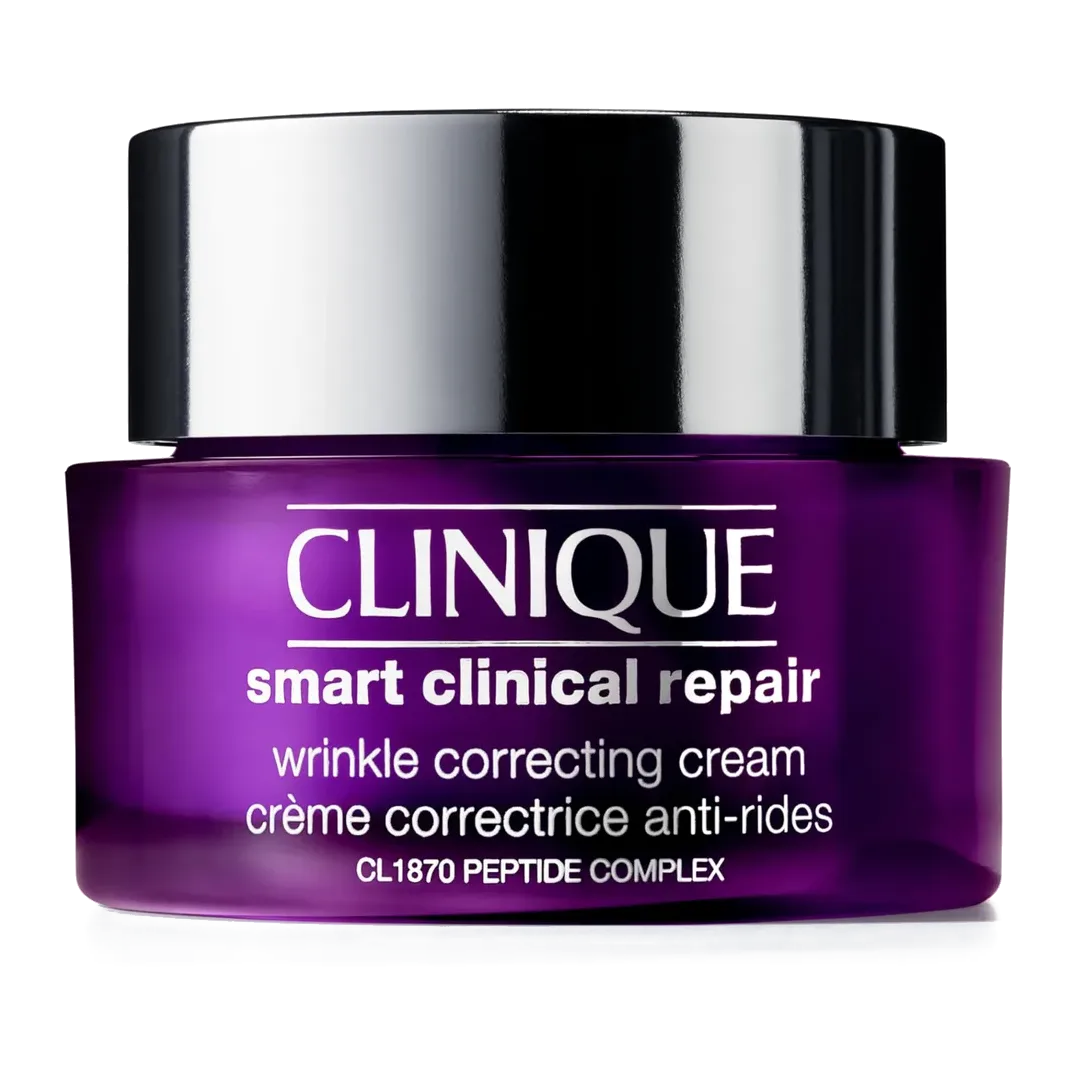
2. Clinique – Smart Clinical Repair Wrinkle Correcting Cream
PROS:
- A real 34% reduction in wrinkle depth, confirmed on the 3D map
- A 31% gain in firmness, the strongest all-rounder after the winner
- Peptide-enriched, with actives small enough to penetrate
- Fragrance-free and fast-absorbing, the top scorer for sensitive-skin tolerance
CONS:
- Pairs fewer active mechanisms than the winner
- Worked across the whole face, not concentrated into the line
- No instant, same-day fill; the change builds only over the weeks
- Strongest on fine to moderate lines rather than the very deepest folds
VERDICT: The runner-up, and the strongest all-round performer after the winner. Crucially, it clears the first criterion: its peptides are small enough to penetrate, so the scan tracked real, sustained depth reduction of 34%, with a 31% firmness gain and zero irritation.
Where it falls short is the second criterion. It is still a whole-face cream, not a treatment concentrated into the fold, it pairs fewer mechanisms than the winner, and it offers no same-day fill, so the softening builds slowly. For consistent daily use and sensitive skin it is an excellent choice, widely available through Clinique counters and authorized retailers across Europe.
Lab findings:
- Composite Imaging Score 91/100
- Wrinkle depth −34% (confirmed on 3D map)
- Firmness +31%
- The study’s highest sensitive-skin tolerance score
For consistent daily use and sensitive skin it is an excellent choice, widely available through Clinique counters and authorized retailers across Europe.
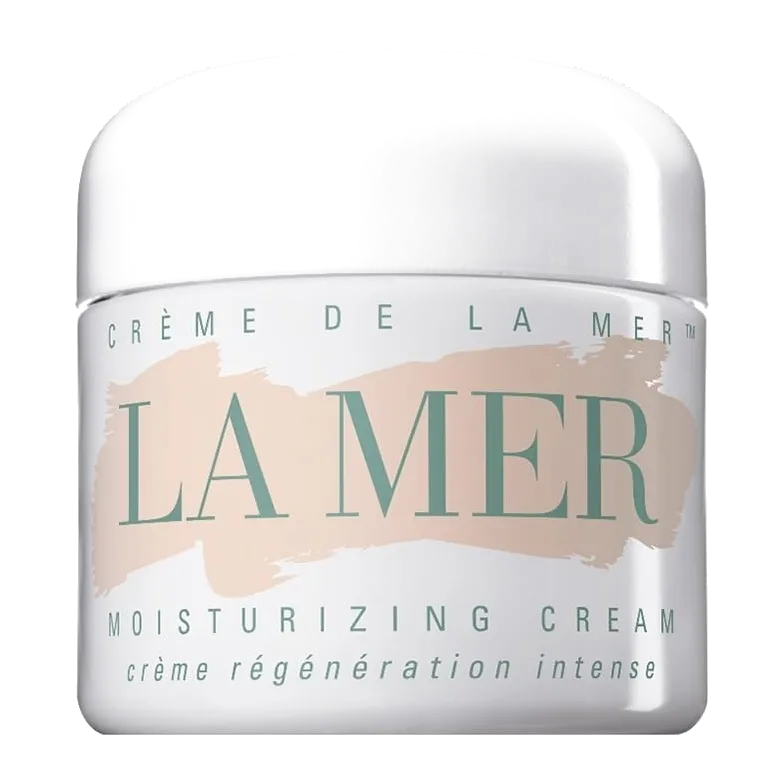
3. La Mer – Crème de la Mer
PROS:
- The study’s highest smoothness and radiance scores
- Centered on the fermented Miracle Broth kelp extract and rich emollients
- The study’s top comfort rating, from 84% of participants
- Excellent compatibility across all skin types, with zero irritation
CONS:
- Works mainly at the surface, with limited effect on the fold
- Runs on a single line of action, not the deeper mechanisms of the top formulas
- Exceptional feel, but modest change on established smile lines
- Premium price for a surface-focused result
VERDICT: The comfort champion, taking the study’s highest smoothness and radiance scores and leaving skin visibly more luminous by week eleven. It feels extraordinary, earning the top comfort rating at 84%.
But the scan told the familiar story of a surface formula. Its marine actives are well documented for hydration and comfort, yet it runs on a single mechanism and stays near the surface, so on a deep fold the change is modest. For radiance, comfort, and hydration it is hard to beat, sold through La Mer counters across Europe.
Lab findings:
- Composite Imaging Score 89/100
- Surface smoothness excellent (its standout metric)
- Hydration high and sustained
- Fold-depth reduction limited over eleven weeks
For radiance, comfort, and hydration it is hard to beat, sold through La Mer counters across Europe.
4. La Prairie – Skin Caviar Luxe Cream
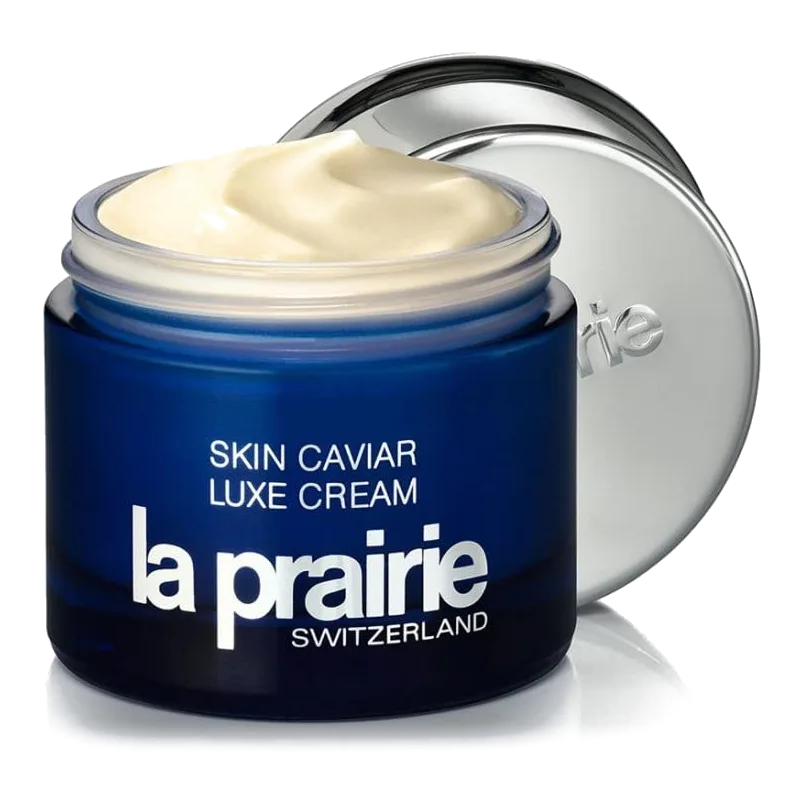
PROS:
- A standout 27% improvement in firmness by week eight
- Built around caviar extract and firming peptides
- Silky, opulent texture with an immediate tightening sensation
- A smooth, primed surface noted by 81% of testers, with flawless tolerance
CONS:
- Deep-line change levels off after the first weeks
- Actives sit below the concentrations needed to act at the depth of the fold
- Strong on firmness, lighter on the smile lines themselves
- Premium price for the deep-line result it returns
VERDICT: The luxury entry, and its strength is firmness, posting a 27% rise by week eight alongside a visibly refined surface. The experience matches the price, with an immediate tightening sensation 81% of testers noticed.
But on the metric that decided this ranking, the depth of the fold, the change leveled off after the first weeks. Its actives are effective for firmness, yet fall below what it takes to reach and soften a deep line, and like every cream here it is worked across the whole face rather than into the crease. For immediate firming and a luxurious ritual it delivers, sold through La Prairie counters across Europe.
Lab findings:
- Composite Imaging Score 88/100
- Firmness +27% (its strongest metric)
- Fold-depth reduction moderate over eleven weeks
For immediate firming and a luxurious ritual it delivers, sold through La Prairie counters across Europe.
5. Rexaline – X-treme Renovator Regenerating Cream
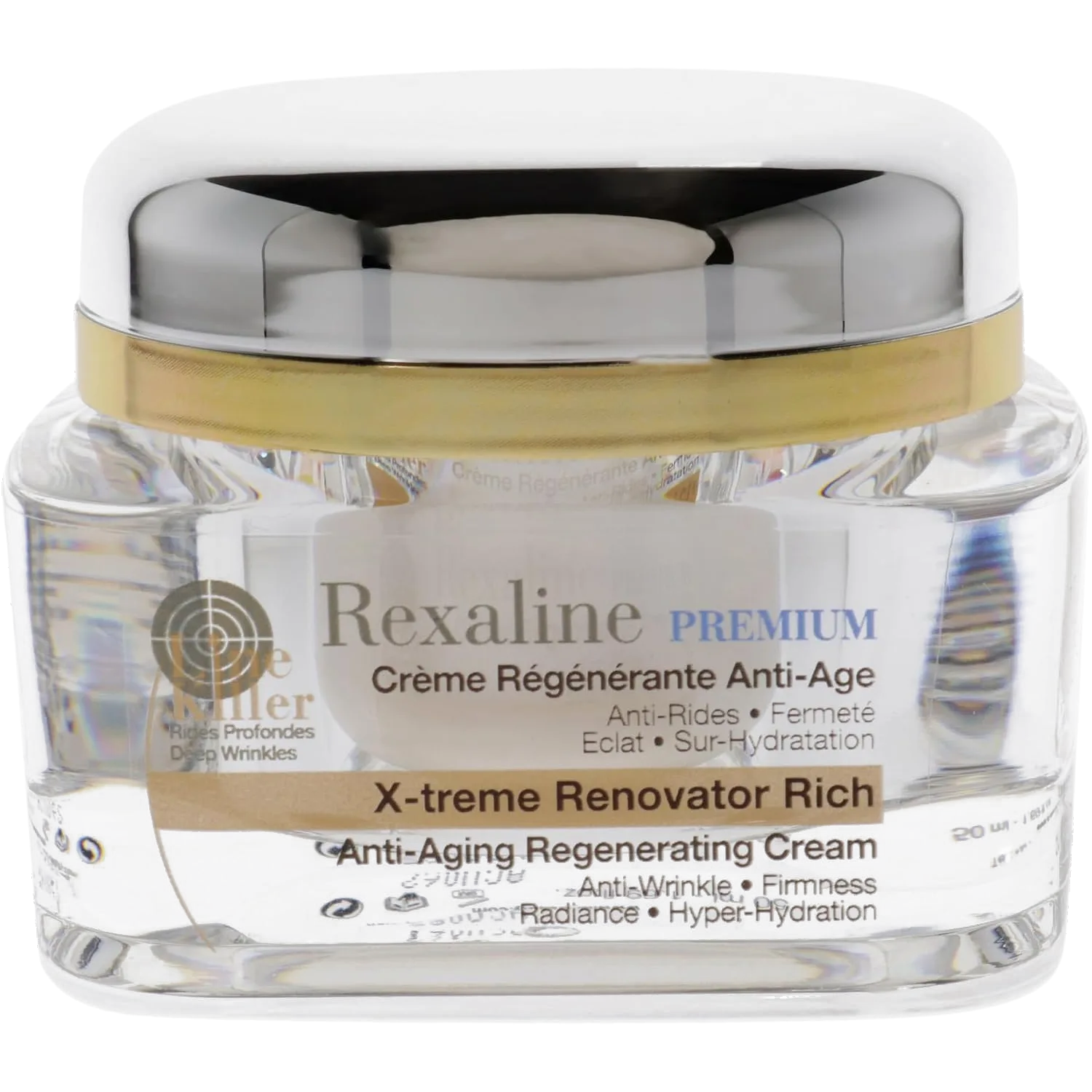
PROS:
- Among the best surface results in the study, 42% smoother across the smile-line zone
- Boosts the skin’s own hyaluronic acid with a mango-butter, vitamin A and E complex
- Absorbs fast with no greasy residue; used as a makeup base by 78% of testers
- Excellent tolerance, well suited to mature skin
CONS:
- Works mainly in the upper layers, and lighter on the depth of the fold itself
- Deep-line results build slowly compared with the top formulas
- A whole-face cream, not a treatment concentrated on the line
- A short adaptation period on very sensitive skin (12% of volunteers)
VERDICT: This is the surface specialist of the group, and on the surface it delivers, with a 42% jump in smoothness and 29% plumping, among the best surface numbers in the study. It is a pleasure to use, absorbing quickly with no greasy film.
But against the first criterion, reaching the fold, the scan showed it working mainly in the upper layers, with deep-line change coming slowly. And spread across the whole face, it never concentrates where a smile line actually sits. For long-term surface hydration and texture it earns its place, sold through pharmacies and select perfumeries across Europe.
Lab findings:
- Composite Imaging Score 87/100
- Surface smoothness +42%
- Surface plumping +29%
- Fold-depth reduction measurable but slow, emerging after week 4.
For long-term surface hydration and texture it earns its place, sold through pharmacies and select perfumeries across Europe.
The Top 5 At A Glance
- Deepest smile-line reduction — Cellexia Deep Wrinkle Filler Gel (#1). Index 96. The only formula to meet both criteria: small actives that reach the fold, delivered by precision tip straight into the line, plus an instant optical fill. 52% depth reduction, fast and lasting. Limited stock, with possible 2 to 3 month waits.
- Best for sensitive skin — Clinique Smart Clinical Repair (#2). Index 91. Penetrating peptides, 34% depth reduction with zero irritation, but a whole-face cream with no instant fill. Widely available.
- Best for radiance and comfort — La Mer Crème de la Mer (#3). Index 89. Top comfort and smoothness scores, surface-focused. Widely available.
- Best for immediate firming — La Prairie Skin Caviar Luxe (#4). Index 88. 27% firmness gain, luxury finish. Premium counters.
- Best for long-term hydration — Rexaline X-treme Renovator (#5). Index 87. 42% surface smoothness, gradual results. Pharmacies and perfumeries.
Sources
- The Esthetics of the Nasolabial Fold and Age in the Elderly Via Eye-Tracking – Bertossi D, et al. (2023), Contemporary Clinical Dentistry
- The 500 Dalton Rule for the Skin Penetration of Chemical Compounds and Drugs – Bos JD, Meinardi MMHM (2000), Experimental Dermatology, 9(3):165-169
- Human Skin Penetration of Hyaluronic Acid of Different Molecular Weights as Probed by Raman Spectroscopy – Essendoubi M, Gobinet C, Reynaud R, Angiboust JF, Manfait M, Piot O (2016), Skin Research and Technology, 22(1):55-62
- A Classification of Facial Wrinkles – Tsukahara K, et al. (2004), Plastic and Reconstructive Surgery / classification study on facial wrinkles and repeated muscle movement
- Effect of a Facial Muscle Exercise Device on Facial Rejuvenation – Alam M, et al. (2018), Journal of the American Academy of Dermatology (PMC5888959)
- Update on Low-Molecular Weight Hyaluronic Acid in Dermatology: A Scoping Review – European Medical Journal Dermatology (2023/2024)
- The Efficacy and Safety of CollaSel Pro Hydrolyzed Collagen Peptide Supplementation in Improving Skin Health in Adult Females: A Double-Blind, Randomized, Placebo-Controlled Clinical Study Using Biophysical and Skin Imaging Techniques – (2024), PMC11432272
- Sequential MRI as a Diagnostic Tool for Follow-Up of Hyaluronic Acid Dermal Filler, in a Woman Who Underwent Radiation Therapy for Oral Cancer – Bettini S, et al. (2025), Clinical Case Reports, PMC11978728
Dr. Elin Larsson – Consultant Dermatologist, Stockholm. A graduate in Medicine from the Karolinska Institutet, she completed her dermatology specialisation in Sweden and has spent over fifteen years treating a wide range of skin conditions, publishing on sensitive skin management in European dermatology journals.
Dr. Matteo Bianchi – Cosmetic Chemist, Milan. Holding a doctorate in Cosmetic Science from the University of Milan, he has spent over twelve years formulating skincare products for leading Italian laboratories and regularly advises on ingredient safety and efficacy for consumer publications.
Aoife Murphy – Clinical Nutritionist, Dublin. A graduate of University College Dublin with a Master’s in Human Nutrition, she has practised for over ten years advising on diet-related skin health and has contributed nutrition guidance to several European wellness magazines.