
Zofia Nowak, Staff Writer.
The bathroom mirror never lies before eight in the morning, but by the school run your liner has migrated onto your under-eye like a bruise you did not earn. You have tried three different “waterproof” pens this year alone, and the drawer under the sink is a small graveyard of half-used tubes that promised twelve hours and gave you four. The question you actually type into a search bar at midnight is not which brand everyone recommends. It is simpler: how do you know, before you even open the packet, whether this one will hold through a humid commute, a swim, or a long cry at a wedding. Here is one fact worth knowing before anything else: “waterproof” is not a regulated term in European cosmetics labelling, so two liners carrying the identical claim can behave in entirely different ways on the same eyelid. This guide teaches you to read a liner the way a formulation chemist does, so you stop guessing at the counter and start judging for yourself.
- Waterproof is a marketing word, not a legal standard: the ingredient list tells you more than the claim on the box.
- Film-forming polymers, not wax, are what actually resist sebum and water: look for names like trimethylsiloxysilicate, acrylates copolymer or VP/VA copolymer.
- How hard a liner is to remove is itself a quality signal: one that slides off at the first touch of a damp cotton pad will rarely survive a working day either.
Why Your Liner Survives The Office But Fails The Beach
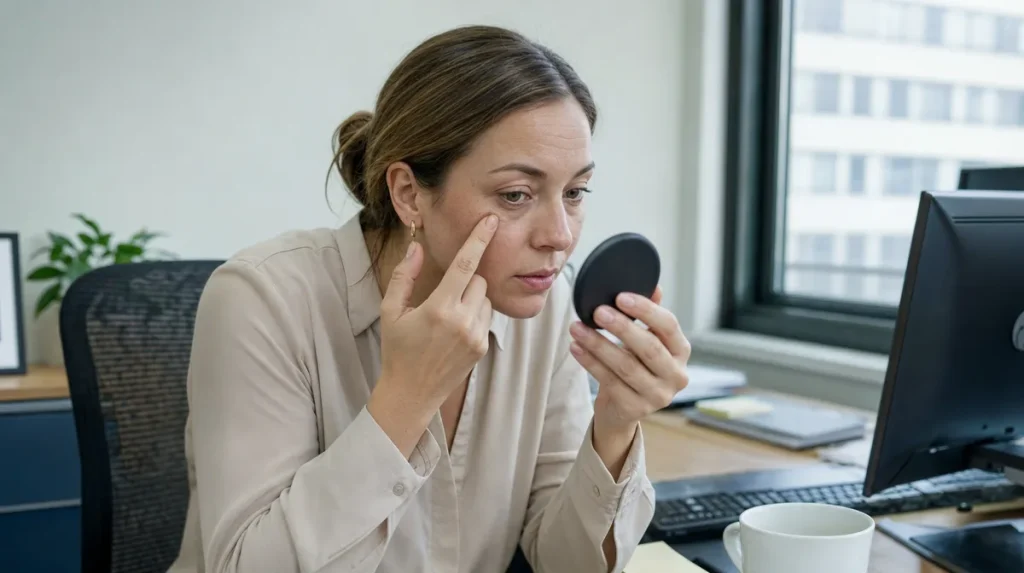
Most people assume waterproof means resistant to water, full stop. In practice, two separate threats attack eye makeup over the course of a day, and they are not the same thing. On the lid itself, the main enemy is sebum, the skin’s own oil, which softens pigment and causes smudging around midday even indoors. Along the lower lash line, the enemy is more often moisture: tears, humidity, a splash of water at the sink.
Think of it the way you would think about outdoor clothing. A raincoat is built to shed water, but it will not protect you from a kitchen full of cooking fat. A formula engineered against water droplets is not automatically engineered against the skin’s own oils, and a formula that resists smudging on an oily lid is not automatically tear-proof. A 2023 study in the Journal of Cosmetic Science comparing wear-time formulas found that sebum-induced fading and water-induced fading followed measurably different breakdown patterns, which is one reason a single “waterproof” claim can mean very different things in practice.
The practical upshot: before buying, ask yourself which failure you are actually trying to solve. Smudging by lunchtime points to an oil problem. Streaking after a swim or a cry points to a water problem. The best formula for you depends on which one keeps happening to you.
Reading The Ingredient List Like A Chemist
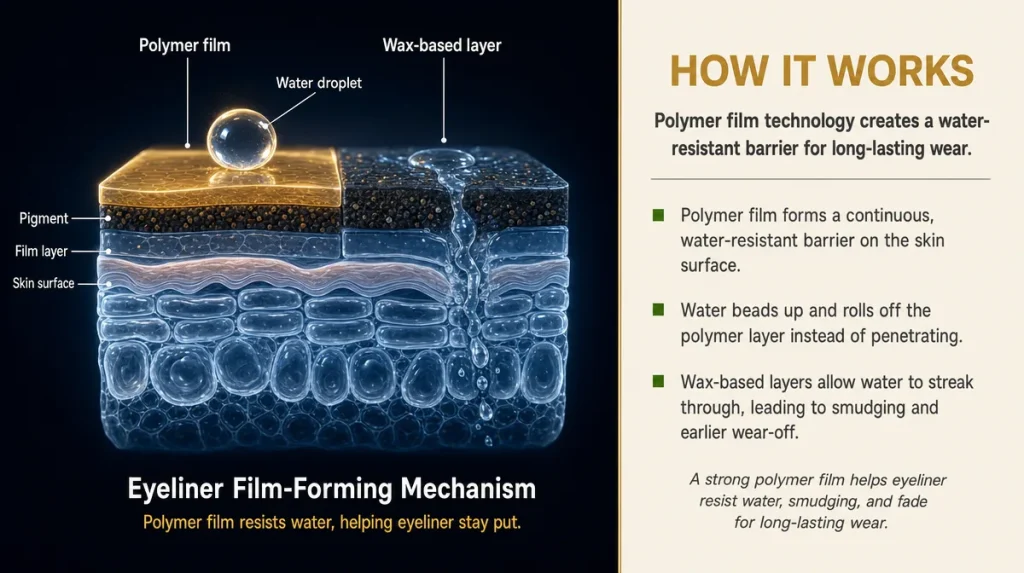
Flip the box over and the ingredient list, not the front label, is where the real answer sits. Two families of ingredients do the heavy lifting in long-wear eyeliners.
Film-forming polymers, such as trimethylsiloxysilicate, acrylates copolymer or VP/VA copolymer, dry into a thin, flexible, largely water-insoluble layer that locks pigment against the skin. These are the ingredients behind genuinely long-wearing, water-resistant formulas, and the underlying chemistry has been documented in congress papers presented to the International Federation of Societies of Cosmetic Chemists for years.
Wax-based formulas, built on candelilla wax, ozokerite or similar, behave differently. They sit on the skin as a softer, richer layer, which is why wax-heavy pencils often glide on more smoothly and deliver denser colour payoff. The trade-off is that wax is more easily disturbed by heat, oil and water, so these formulas tend to fade faster in warm, humid conditions.
Neither family is inherently superior. A wax-based pencil used for a daytime look in a cool office has little to prove. The same pencil on a beach holiday in August is working against its own chemistry.
A Two-minute Test You Can Do Before You Buy
You do not need a laboratory to get a reasonable read on a formula. Most pharmacies allow testers, and the same test works at home once you own the product.
Draw a short line on the back of your hand, in the same spot you would normally test a foundation shade. Let it dry undisturbed for two full minutes, since many of these formulas need that time to finish forming their film. Then run the spot under cold water for ten seconds, or press a damp cotton pad against it with light, even pressure, the kind of pressure a tear or a splashed face would apply.
A genuinely water-resistant formula will still be visibly intact, perhaps slightly softened at the edges. A formula that smears across your hand at this stage will almost certainly smear across your face by early afternoon. Repeat the same test after rubbing a little facial oil or moisturiser into the skin first, which mimics an oily lid rather than clean skin, since that is the condition the liner actually has to survive.
Liquid, Pencil Or Gel: The Mechanism Behind Each Format
The format on the shelf is really shorthand for a different chemical approach.
Liquid liners are typically solvent-based suspensions of polymer and pigment. As the solvent evaporates, the polymer sets into a precise, high-definition film, which is why liquids tend to give the cleanest line and the longest wear, at the cost of being less forgiving to apply.
Pencils build their base from waxes and oils, which keeps the tip soft enough to glide, but means the finished line stays slightly more pliable and therefore more vulnerable to heat and friction throughout the day.
Gel liners, usually sold in a small pot with a brush, sit between the two. They often combine wax with silicone elastomers, giving a softer application than a liquid with somewhat better resistance than a classic pencil.
None of this means one format is objectively “better”. A liquid liner on hooded eyelids that crease repeatedly can transfer onto the crease itself, while a gel or pencil, used thinly, may behave more predictably there. Matching the mechanism to your own eye shape and skin type matters more than chasing whichever format is fashionable that season.
Mistakes That Undo An Otherwise Good Liner
Even a well-formulated polymer liner fails for predictable, avoidable reasons.
Applying it directly over a freshly moisturised lid is the most common one. Moisturiser and most eye creams contain emollients designed to sit on the skin, which is exactly the surface a film-forming polymer needs to bond to directly. Wait for skincare to fully absorb, generally a few minutes, before going near the eye with liner.
The second mistake is not giving liquid or gel formulas time to set before adding a second coat or touching the area. Layering wet product onto wet product prevents either layer from forming a stable film, so the finished line stays tacky and transfers onto the upper lid or under the brow bone.
The third is removal technique rather than application. Rubbing at smudged liner through the day, rather than waiting until proper makeup remover is available, breaks the film into fine particles that then migrate further across the skin, often leaving more mess than if the liner had simply been left alone until cleansing.
What Removal Tells You About Quality
Counterintuitively, a liner that is slightly harder to remove than a basic kohl pencil is usually doing its job properly, and this can be used as a quality check in itself.
A well-made waterproof formula typically needs an oil-based cleanser or a micellar water formulated for eye makeup to dissolve the film. Once the right product is applied, it should lift away within roughly thirty to sixty seconds of gentle pressure, not vigorous scrubbing. The oil molecules work their way into the polymer structure and break it apart, releasing the pigment gradually rather than all at once.
If a liner comes away instantly with plain water, it likely lacked the film-forming chemistry to survive the day in the first place. If it only comes away after hard rubbing, that is also a signal, since repeated friction that close to the eye is a known contributor to lash-line irritation, a point reflected in general public guidance from the European Academy of Dermatology and Venereology on eye-area cosmetics. The middle ground, needing the right remover but not force, is the sign of a formula doing exactly what it claims.
Sensitive Eyes, Lenses And What Matters For Safety
For contact lens wearers, general guidance referenced by European dermatology bodies advises against applying any eyeliner, waterproof or otherwise, to the inner waterline, since product there sits closest to the tear film and the lens surface. Lining just above the upper lash line or along the lower lash line, rather than inside it, reduces this contact considerably.
Fragrance-free formulations are worth seeking out if your eyes tend to water or sting, since fragrance is a frequent contributor to eye-area sensitivity even in products otherwise well tolerated elsewhere on the face. Loose glitter or very fine shimmer particles are also worth avoiding close to the lash line, as stray particles can migrate onto the eye’s surface.
Trade guidance published by Cosmetics Europe on eye-area cosmetics generally recommends that such products undergo ophthalmological testing before claiming suitability for sensitive eyes, which is useful context when you see that phrase on packaging: it describes a testing protocol, not a guarantee that every eye will tolerate the formula equally well.
What Counts As Genuine Performance, And What Is Just Marketing Language
Beauty pages in publications such as ELLE and Harper’s Bazaar have run sweat-test and swim-test comparisons on long-wear makeup for decades, and the better ones disclose their conditions: how many hours, what activity, how many testers. That kind of disclosure is useful. A bare claim of “24-hour wear” with no stated conditions tells you almost nothing, since twenty-four hours of sitting at a desk and twenty-four hours including a swim and a gym session are not comparable tests.
Phrases worth treating with mild scepticism include “tested by experts”, with no named methodology, and “clinically proven”, when no study details are offered. Phrases worth taking more seriously include specific percentages tied to a described test, a stated panel size, or a named independent laboratory. None of this requires a chemistry degree to apply, only the habit of asking what, exactly, was measured.
Climate matters here too. A formula that performs reliably through a Nordic winter, where central heating keeps indoor air dry and lids less oily, may behave differently during a Mediterranean summer, when higher humidity and sun exposure increase both sweat and sebum production. If you holiday somewhere hot, it is worth retesting a trusted formula under those conditions rather than assuming last winter’s results still apply.
Key Takeaways
- Waterproof is marketing shorthand, not a regulated standard: judge the formula, not the word on the box.
- Film-forming polymers resist sebum and water far more reliably than wax-based formulas, though wax often applies more smoothly.
- A two-minute hand test, including a dab of oil first, tells you more than any packaging claim.
- Removal difficulty is informative: too easy suggests a weak film, too hard suggests unnecessary friction near the eye.
- Match the format, liquid, pencil or gel, to your own eye shape, skin type and the climate you are actually living or travelling in.
A Checklist Before You Buy
- Check the ingredient list for a film-forming polymer, not just wax, if long wear is the priority.
- Test on the back of your hand, including under a smear of facial oil, before testing near the eye.
- Avoid lining the inner waterline, especially if you wear contact lenses.
- Choose fragrance-free if your eyes are prone to watering or irritation.
- Keep an oil-based or micellar remover on hand rather than relying on soap and water.
- Reassess your usual formula if your climate or season changes significantly.
This guide offers general information and does not replace advice from a dermatologist or pharmacist.
Individual results vary depending on skin type, climate and application technique.