
Henrik Voss, Senior Health and Science Editor.
There is a shelf in most bathrooms that tells its own story: three or four bottles, each used twice, each smelling wonderful in the shop and faintly wrong at home. The question that actually gets typed into a search bar at midnight is usually some version of ‘why does my perfume smell different on me’. The honest answer is that eau de parfum behaves less like a single product and more like a small chemistry experiment involving your skin, the room temperature, and how long you are willing to wait before judging it. A fragrance needs roughly 20 to 30 minutes on skin before its true character appears, according to formulation guidance published by the International Federation of Societies of Cosmetic Chemists. This guide is about learning to read a bottle, a strip, and your own skin, so that the next purchase is one you still like in March.
- Concentration is not a compliment: eau de parfum’s higher oil-to-alcohol ratio changes how long a scent lasts, not how luxurious it is.
- Skin decides more than the bottle does: the same fragrance can smell noticeably different from one wrist to another, and that is normal chemistry, not a flaw.
- A sample worn for a full day beats an hour in a shop: real testing means patience, not a quick spray-and-sniff at the counter.
What ‘Eau De Parfum’ Actually Promises
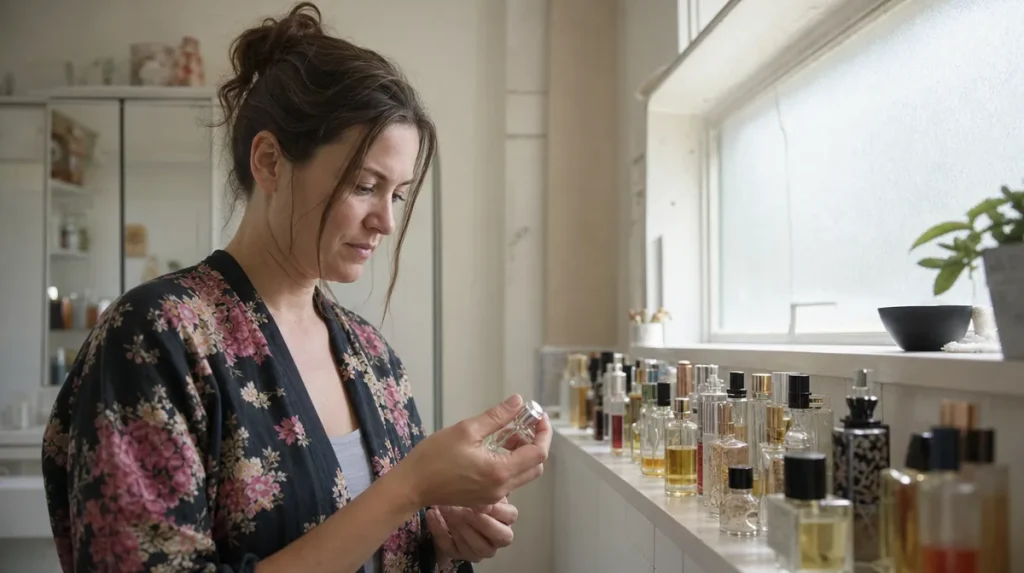
The word ‘parfum’ on a label describes concentration, not quality. Fragrance is built from perfume oil diluted in alcohol and a small amount of water, and the ratio decides the family name. Eau de cologne sits lowest, around 2 to 4 per cent oil. Eau de toilette runs higher, and eau de parfum higher still, typically in the range of 15 to 20 per cent, according to concentration guidance circulated by Cosmetics Europe for consumer information. Think of it the way a barista thinks of espresso against filter coffee: same bean, same basic recipe, but a different ratio of grounds to water produces a stronger, longer-lasting flavour. Neither is better. A stronger concentration simply means the scent will sit on skin longer and project further, which suits some lives and overwhelms others.
Reading The Pyramid Without The Jargon
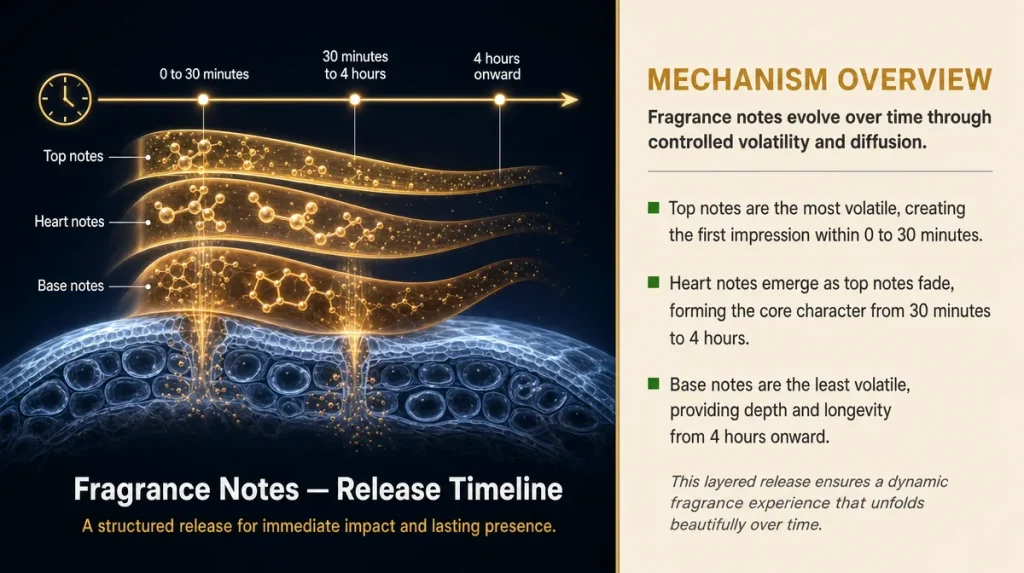
Perfumers describe a scent in three stages, and the structure is worth understanding because it explains why a fragrance you loved in the shop can feel unrecognisable four hours later. Top notes are the citrus or herbal opening, gone within 15 to 30 minutes. Heart notes, often floral or spiced, form the actual personality of the scent and last for the middle hours. Base notes, typically woods, musks or resins, are what remains on your jumper the next morning. It works rather like a three-course meal: the starter is bright and brief, the main course is what you remember, and the dessert lingers after the plates are cleared. Judging a fragrance from the first spray alone is judging a meal by its starter.
Finding A Family You Actually Like
Perfumers group scents into families: floral, oriental (sometimes called amber), woody, fresh, and gourmand among others. Most beginners buy by brand reputation or packaging rather than family, which is why the shelf fills with bottles that do not get finished. A simple self-test helps: at any counter, ask for four blotting strips from clearly different families rather than four bottles that all smell similar. Wave each strip, wait a minute, and notice which one you keep lifting back to your nose without thinking. That instinctive return is a more reliable signal than any description on the box. Over a few visits, a pattern usually emerges, and that pattern is worth more than any single recommendation from a shop assistant working on commission.
Testing On Skin, Not Just On Paper
A blotting strip tells you what a fragrance smells like in isolation. Skin tells you what it smells like on you, and the two answers are often different. Skin carries natural oils, and those oils interact with a fragrance’s base notes in ways paper cannot replicate. A dermatology review published through the European Academy of Dermatology and Venereology notes that skin pH and sebum levels vary enough between individuals to shift how base notes read on the skin surface. It helps to picture two sponges, one dry and one already damp: the same drop of dye spreads and settles differently on each. Apply a test spray to the inside of your wrist or elbow, then leave it alone for several hours before deciding anything.
Applying For Lasting Power Without Overdoing It
Pulse points, the wrists, the inner elbows, the base of the throat, run slightly warmer than the rest of the body, and warmth helps a fragrance diffuse. Spraying there is sound practice. Rubbing the wrists together afterwards is the most common mistake, and it is worth stopping: friction generates a small amount of heat that breaks down the more delicate top-note molecules before they have a chance to unfold properly. A lighter approach works better: spray, then let the skin absorb it undisturbed. Layering a matching unscented moisturiser underneath can extend wear, since dry skin holds fragrance less well than skin with some hydration, a point echoed in general skincare guidance from Cosmetics Europe.
Storing A Bottle So It Still Smells Right In A Year
Heat, light and air are the three enemies of a fragrance, and a bathroom cabinet often supplies all three through steam, sunlight through frosted glass, and repeated opening. A cooler, darker spot, such as a bedroom drawer or the original box on a wardrobe shelf, keeps a bottle stable for longer. Most eau de parfum holds its character for three to five years once opened, though citrus-heavy scents fade faster than woody or amber ones. A fragrance that has turned slightly sour or lost its top notes entirely is not dangerous to wear, but it is no longer doing the job you paid for. If a bottle has sat half full for two summers running, that is usually a sign it was never quite the right choice.
Sensitivity, Allergens And When To Be Cautious
Fragrance is one of the more common causes of contact skin irritation, and the European Academy of Dermatology and Venereology’s public guidance recommends patch-testing any new fragrance on a small area of skin, such as the inner forearm, and waiting 24 to 48 hours before wider use. This matters more for eau de parfum precisely because its higher concentration means more of the irritating compounds sit on skin for longer. People with eczema, very dry skin or a known sensitivity to specific allergens listed on packaging, such as linalool or limonene, may find fragrance-free moisturiser underneath helps, or may need to apply scent to clothing rather than skin. None of this is a reason to avoid fragrance altogether. It is simply a reason to introduce anything new slowly.
Where To Spend And Where To Skip
A full bottle is a commitment, and buying one blind, based on a single spray at a counter, is the single most expensive mistake in this category. Sample vials and discovery sets, widely available through multi-brand retailers such as Sephora, Douglas or Notino, cost a fraction of a full bottle and let you live with a scent through a full day, including how it behaves after a coffee, a walk, or an evening indoors with the heating on. Concentration matters more than the marketing story stamped on the box: an eau de toilette from a modest range can outperform an eau de parfum from a well-known name if the base notes are better balanced. Waiting for seasonal offers, whether the January sales or the pan-European Black Friday period, is a reasonable way to buy a bottle you have already tested for weeks, but it is a poor reason to buy one you have only smelled once.
Key Takeaways
Concentration describes staying power, not status. The same scent reads differently on different skin, and that is chemistry rather than a fault in the fragrance or in you. Testing properly means blotting strips first, then skin, then genuine time, not a single sniff at a counter. Storage away from heat, light and steam keeps a bottle honest for years rather than months. Patch-testing anything new protects sensitive skin without requiring you to give up fragrance altogether.
A Short Checklist Before You Buy
- Ask for a sample or discovery vial rather than committing to a full bottle on a first impression.
- Test on skin, at a pulse point, and wait at least four hours before judging the result.
- Note the family (floral, woody, fresh, oriental, gourmand) that you keep returning to across several visits.
- Store bottles away from bathroom steam and direct sunlight, ideally in their original box.
- Patch-test on the inner forearm and wait 24 to 48 hours if you have sensitive or eczema-prone skin.
- Let a fragrance’s base notes, not its opening spray, decide whether it earns a place on the shelf.
This article is for general information only and is not a substitute for professional dermatological advice.
Individual results and skin reactions vary; patch-test any new fragrance before regular use.