
Zofia Nowak, Staff Writer.
You are standing at the bathroom sink, looking at a shelf of half-finished bottles: a foaming cleanser from last winter, a toner nobody quite remembers buying, and a blue-capped bottle of micellar water a friend swore by. The question you actually type into a search bar late at night is simpler than any product name: am I even using this right? This guide answers that plainly, with the mechanism, the method and the moments when micellar water is the wrong tool entirely. One fact worth keeping in your back pocket: a cotton pad that still looks clean after wiping is not proof of a clean face. It may simply mean the pad was too dry to pick anything up.
- A single wipe rarely finishes the job: most faces need two to three passes with a fresh section of pad before the cotton comes away clean, not one heroic swipe.
- Micellar water is a cleanser, not a treatment: it lifts oil, makeup and grime; it does not exfoliate, brighten or treat blemishes, whatever the label suggests.
- Whether you rinse after depends on your skin, not the marketing: drier or reactive skin generally does better with a rinse afterwards, while robust, oilier skin often does not need one.
What Is Actually Happening On The Cotton Pad
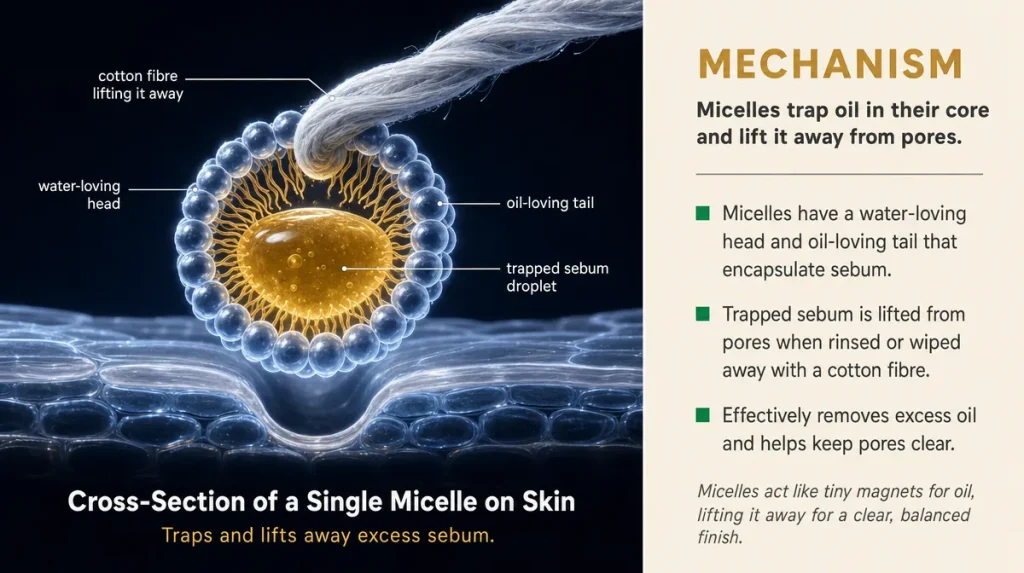
Micellar water gets its name from micelles, tiny spherical clusters that form when a mild surfactant dissolves in soft water. Think of washing-up liquid loosening grease from a plate: the surfactant’s tail dissolves into the oil, its head stays in the water, and together they lift the grease away instead of needing a scrub. A micelle does much the same on skin, at a gentler concentration, surrounding a speck of sebum, sunscreen or foundation and holding it suspended until the cotton pad carries it off.
A 2019 IFSCC congress paper on mild surfactant systems described this as a two-in-one action: the product cleanses and removes make-up in the same gesture, without the rinsing step a foaming cleanser needs. Cosmetics Europe’s general guidance on gentle cleansing echoes the same principle: lower surfactant concentrations, applied without vigorous rubbing, tend to disturb the skin barrier less than high-foam formulas.
That is the appeal, and also the limit. A micelle can only carry off what actually dissolves into it. Waterproof mascara, heavy SPF 50 sunscreen and long-wear foundation are formulated to resist exactly this kind of gentle lifting, which is why one pass over a fully made-up face so often leaves a faint grey smear rather than a clean canvas.
The Three-pass Method That Actually Works
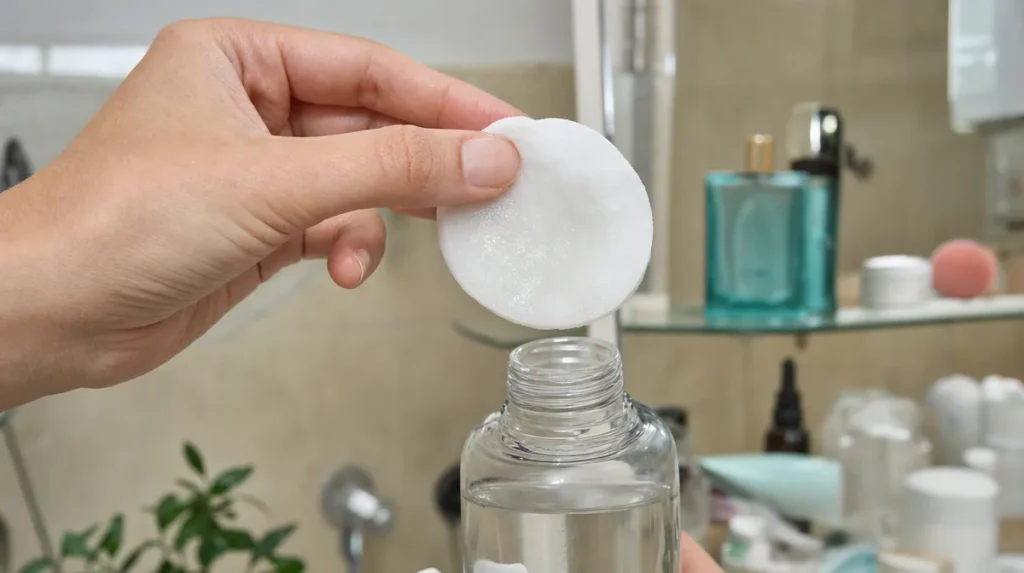
Soak the cotton pad properly first. A pad that is merely damp will drag at the skin rather than glide, and dragging is where irritation starts. Hold the pad against the bottle opening, or pour a coin-sized pool into your palm, and let it soak through before it touches your face.
Start at the eyes, working from the inner corner outward, and hold the pad in place for three to five seconds over closed lids before wiping. Eye make-up, particularly mascara, needs a moment of dwell time to loosen rather than a quick swipe.
Move to the rest of the face with a fresh section of the pad, or a second pad if the first has visibly picked up a lot. Work in one direction rather than a scrubbing motion: forehead, cheeks, nose, chin, jawline.
Take a third, lighter pass with a clean section as a check. If it comes away with any visible colour or residue, repeat the second step rather than pressing on regardless. Two or three passes is normal; needing five or six usually means the makeup that day was heavier than micellar water alone is built to handle.
The Mistakes That Undo The Whole Point
The most common mistake is reusing the same section of a cotton pad across the whole face. Once a patch of cotton is loaded with oil and pigment, dragging it over fresh skin simply redistributes what it already picked up, which is one reason breakouts along the jaw sometimes trace back to the cleansing step rather than anything applied afterwards.
The second is treating micellar water as an exfoliant. It removes what sits on the surface; it does not lift dead skin cells already bonded there, and pressing harder to compensate only irritates the skin without achieving that.
The third is skipping the third pass out of habit. Most people learned a one-wipe routine from packaging that shows a single elegant swipe, but the visible result on the pad, not the number of wipes a bottle photograph implies, is the honest test.
A smaller, quieter mistake: applying it cold, straight from a bag or a windowsill in winter. Skin that has just come in from low temperatures tightens slightly, and a cold liquid on tightened skin reads as more uncomfortable than the product itself actually is. Letting the bottle sit at room temperature for a few minutes solves this without changing the formula at all.
How To Judge Whether It Actually Worked
There are two honest tests, and neither involves a mirror under bright light. First, the pad test already mentioned: your final pass should come away with no visible colour and only a faint dampness, nothing more. Second, run a clean finger lightly across your cheek. If it glides, the surface oil and makeup have gone. If it catches slightly or feels tacky, something is still sitting there.
Results here are immediate, not cumulative. Micellar water is not a product that needs weeks to show its effect, unlike a retinoid or an exfoliating acid. If your skin looks the same after cleansing as before it, the issue is technique or product match, not patience.
Skin that still feels tight or slightly stripped ten minutes after cleansing, particularly once central heating comes on in autumn, is telling you something too: either the formula is more stripping than your skin currently needs, or a rinse and a moisturiser afterwards are missing from the routine. A 2021 study in the Journal of Cosmetic Science following surfactant-cleansed skin over several hours found that residual tightness beyond fifteen minutes correlated with a measurable, if temporary, dip in surface hydration, a reasonable proxy for whether a given cleanser suits a given skin that week.
What Matters On The Label, And What Is Just Marketing
The word ‘micellar’ is not a proprietary technology. It describes a cleansing mechanism that dozens of formulas across every price point use, so the word on its own promises nothing about gentleness or quality.
What is worth reading for: a fragrance-free version if your skin reacts to scent, since fragrance remains one of the more common triggers of contact irritation according to dermatology guidance circulated by the EADV. A pH close to skin’s own, typically stated as ‘skin pH’ or given as a number between roughly 4.5 and 6.5, matters more for comfort over time than most other claims on the bottle.
What is largely decorative: added botanical extracts in trace amounts, claims of ‘3-in-1’ or ‘5-in-1’ action (most micellar waters have always removed light makeup, cleansed and left a residue-free finish; that is one action described three ways), and pastel packaging suggesting a formula ‘for sensitive skin’ without a fragrance-free line to back it up. None of this is dishonest exactly. It is simply not the part of the label that predicts how your skin will feel twenty minutes after using it.
A Two-minute Patch Test Before You Commit
Before a new bottle becomes a daily habit, test it properly. Apply a small amount to a cotton pad and hold it against the inside of your forearm, near the elbow crease, where skin is thinner and reacts faster than on the cheek. Leave the product to dry naturally and check the spot after twenty minutes, then again after twenty-four hours.
Mild, brief tingling that fades within a minute is common with active surfactants and is not, on its own, a reason to stop. Redness, itching or small bumps that appear or worsen over the following day are.
This costs two minutes and one cotton pad, against a face full of active ingredient if the formula does not suit you. It is a habit worth keeping for any new cleanser, not micellar water alone, and it matters more for anyone who already knows their skin reacts to fragrance or to a specific preservative family.
When Micellar Water Is Not Enough On Its Own
On a day with waterproof mascara, a full face of long-wear foundation, or SPF 50 sunscreen worn from breakfast to evening, one round of micellar water is unlikely to fully clear the skin. This is where a second cleanse, sometimes called double cleansing, earns its place: micellar water or a similar first step to break down makeup and sunscreen, followed by a water-based cleanser to remove what is left and to actually rinse the skin.
Skipping the second step on heavy-makeup days is one of the more common reasons people report clogged pores despite cleansing every night; the first pass has genuinely lifted the makeup off the skin’s surface, but without a rinse it can be redeposited thinly across the face rather than washed away.
On lighter days, no makeup, a plain moisturiser and an SPF, micellar water alone is usually sufficient, particularly in the evening. This is also a fair moment to note the seasonal point: skin under constant central heating through a northern European winter tends to run drier regardless of cleanser choice, so a rinse-off step followed promptly by moisturiser matters more from October to March than it does in a Mediterranean August, when the concern shifts toward removing SPF residue and sweat rather than dryness.
Buying, Storing And Knowing When A Bottle Has Turned
Micellar water is sold everywhere from the pharmacy to Sephora, Douglas and Notino, and price differences between them rarely track quality in any consistent way; the mechanism described earlier works much the same whether the bottle costs very little or considerably more.
Once opened, most formulas hold up well for around six months if kept away from direct sunlight and heat, both of which can destabilise the surfactant system slowly over time. A bottle left on a bright bathroom windowsill through a hot summer will not turn dangerous, but it may become noticeably less effective by the time you reach the bottom third.
A formula that has separated visibly, smells different from when it was new, or leaves skin feeling unusually tight after a normal cleanse has likely passed its useful life, whatever the printed expiry date says. Trust the skin’s response over the date on the box.
Key Takeaways
- Two to three passes with a fresh section of cotton beats one heroic swipe.
- Micellar water cleanses and lifts makeup; it does not exfoliate or treat skin concerns.
- Rinsing afterwards suits drier or reactive skin; it is optional for oilier, more resilient skin.
- Heavy makeup, waterproof formulas and all-day SPF usually need a second, water-based cleanse.
- Patch test any new formula on the inner forearm before it becomes a nightly habit.
A Quick Checklist For The Shelf
- Fragrance-free option if your skin reacts to scent
- pH stated near skin’s natural range
- Stored away from direct sunlight and heat
- Used within about six months of opening
- Followed by a rinse and moisturiser on drier days or through winter heating months
This guide offers general information and is not a substitute for personalised dermatological advice.
Individual skin responses vary; results and comfort levels described here may not apply to everyone.