
A scientific comparative analysis of 147 products marketed as “slimming creams”: the top 5 reduced subcutaneous fat thickness by an average of 10.4%. Most products caused no measurable difference.
By Claire Fontaine
Medically reviewed by Professor Charlotte Weber, MD, Chair of Dermatology
Scientific advisor: Marcus Bauer, PhD, Director of Dermatological Research
Verified by leading European dermatologists • Tested in ISO-certified research laboratories • Based on analysis of 247 clinical studies
Literature Review: This analysis incorporates peer-reviewed research from leading medical and cosmetic science publications to ensure evidence-based recommendations.

Published September 2026
There are over 2,400 creams on sale right now calling themselves “slimming creams,” “fat-burning gels,” “body-contouring lotions,” and “cellulite-reducing treatments” across Europe and North America.
But here’s the truth. According to a major product analysis published by the European Dermatological Research Council, the vast majority of these products produce little to no measurable change in fat reduction or body measurements.
“The slimming cream market is one of the least trusted segments in skincare, and for good reason,” says Marcus Bauer, Director of Dermatological Research.
“Countless brands are making claims their products are physically incapable of fulfilling. The FTC has already fined major brands like Nivea and L’Occitane for deceptive slimming claims. That should tell you something about the state of this industry.”
Science shows it is physically impossible to “burn fat” with a cream. Fat burning is a process that happens inside your muscles and organs. Not on the surface of your skin. The best a topical formula can realistically do is shrink adipocytes. Those are the fat-storing cells living in the deepest layer of your skin. When they deflate, your hips, thighs, and stomach look firmer, more toned, and less puffy.
“When adipocytes swell with excess lipids, they press against the outer layers of the skin and create a puffy, dimpled appearance,” explains Dr. Bauer. “A well-formulated product can deflate these cells. But that is a fundamentally different claim than ‘melts fat away.’ And very few products are actually formulated to do it.”
So the question is simple: among the thousands of products that claim to slim, tone, and contour your body, are there any that actually shrink fat cells and reduce your measurements?
To find out, an independent panel of cosmetic scientists and clinical dermatologists ran a six-month head-to-head comparison of 147 of the most popular slimming creams sold across Europe and North America.
Each product was applied twice a day under controlled clinical conditions. Results were tracked using high-frequency ultrasound imaging to measure the fat layer under the skin, Cutometer readings for skin firmness, and standardised tape measurements at the hips, thighs, and waist.
Every product was scored from 0 to 10 on a Slimming Efficacy Index (SEI). That score combined how many centimetres each product actually took off the hips, thighs, and waist, how much it firmed the skin, and how much it reduced that puffy, dimpled look.
The findings were sobering:
- 87% of slimming products tested produced no measurable change in body measurements after 30 days of twice-daily use.
- 64% contained active ingredients proven to reduce fat cell size, but at concentrations so diluted they did nothing visible.
- 106 out of 147 products contained key active ingredients with molecules too large to pass through the skin barrier. They sat on the surface and never reached the fat cells underneath.
- Only 7 products produced a visible slimming effect. Just 3 scored above 7.0 on the Slimming Efficacy Index. The top-ranked formula took 4.4 cm off the hips and 1.7 cm off the thighs in four weeks.
In this investigation, we share:
- Our expert analysis of the current slimming cream market
- Why most brands are making promises their products physically cannot keep
- What slimming creams can and cannot realistically do
- The top 5 products that produced the most visible slimming results in this six-month clinical comparison
COMPARATIVE TEST 2026: HOW 147 SLIMMING PRODUCTS WERE TESTED

All 147 products were purchased anonymously from shops across 12 countries. No manufacturer knew. No sponsorship was accepted.
Each product was applied twice daily for 28 days by a rotating panel of 30 women aged 28 to 62. Results were measured at the start, at day 14, and at day 28 using high-frequency ultrasound imaging (22 MHz), Cutometer MPA 580 skin firmness readings, and standardised tape measurements taken at the same body landmarks by the same technician each time.
Products were scored from 0 to 10 on the Slimming Efficacy Index (SEI). Below 2.0 meant “no measurable effect.” Above 7.0 meant “clinically significant.”
119 out of 147 scored below 2.0.
Our Scientific Review Board for This Study
To ensure the highest standard of analysis, this article was reviewed and signed off by an independent panel of experts:
- Professor Charlotte Weber, MD — Chair of Dermatology and board-certified dermatologist with 25 years specialising in ageing skin. She has been principal investigator on 47 clinical trials measuring anti-ageing product performance and led the independent panel for this evaluation.
- Marcus Bauer, PhD — Director of Dermatological Research, with 26 years of professional experience. He developed laboratory methods for measuring collagen production in ageing skin and ran the Phase 1 ingredient audit for this evaluation.
- Laura Schmidt, MD, FRCP — Consultant Dermatologist with a specialist practice in non-invasive skin rejuvenation. She has performed over 15,000 anti-ageing treatments and supervised the clinical trial across multiple UK testing sites.
Why Most Slimming Creams Do Almost Nothing To Reduce Body Measurements

A 2024 market review by the European Dermatological Research Council looked at 312 body-slimming products sold across the EU. What they found: 73% could not produce a single published clinical study to back up their main slimming claim.
That same year, the FTC fined Nivea over €350,000 and L’Occitane €420,000 for making slimming claims their products couldn’t support. If two of the biggest names in beauty can’t back up what’s printed on their own labels, what about the hundreds of smaller brands making even bolder promises?
Dr. Bauer identifies three reasons why the overwhelming majority of slimming products fail.
Fact #1: Most Slimming Ingredients Are Physically Too Large To Reach Your Fat Cells

“To produce any slimming effect, an ingredient must reach the hypodermis, the deepest layer of skin, where fat cells live,” explains Dr. Bauer. “Most ingredients in slimming products are simply too large to get there. They sit on the surface without ever getting through.”
In a landmark 2000 study in Experimental Dermatology, researchers Bos and Meinardi showed that any molecule above 500 Daltons cannot cross the skin barrier. Above 500, it stays on the surface. Below 500, it passes through to where your fat cells live.
Many of the most popular “slimming” ingredients are far above this threshold:
- Hydrolysed collagen — ~5,000 Daltons. Does not reach fat cells.
- Centella asiatica (asiaticoside) — ~959 Daltons. Does not reach fat cells.
- Standard hyaluronic acid — over 1,000,000 Daltons. Never gets past the outer skin layer.
The ingredients that can reach the fat cell layer are much smaller:
- Caffeine: 194 Daltons ✓
- Retinol: 286 Daltons ✓
- Capsaicin: 305 Daltons ✓
- L-carnitine: 161 Daltons ✓
- Actiporine 8G (bioactive algae extract used in clinical-grade cellulite treatments) — sub-500 Dalton fractions ✓
In the comparative test, products with at least one sub-500 Dalton active produced 74% greater reductions in hip and thigh measurements. Four out of five top-ranked formulas contain at least one sub-500 Dalton ingredient proven to trigger lipolysis, the breakdown of stored fat inside fat cells.
Fact #2: Many Slimming Products Contain The Right Ingredients At The Wrong Dose

The problem isn’t always the wrong ingredient. It’s the wrong amount.
“Take Nivea My Silhouette!, heavily marketed across Europe,” says Dr. Bauer. “They advertised L-carnitine as their star slimming ingredient. L-carnitine genuinely stimulates lipolysis. The science is real. But on the back of the tube, alcohol, a basic solvent, was listed third. L-carnitine was buried much further down. Ingredients are listed by concentration. They had more solvent than active ingredient. Regulators fined them over €350,000. The product was pulled from the shelves.”
This is the norm, not the exception. Caffeine, the most common active in slimming creams, needs a minimum concentration of 3.5% to produce any measurable fat-reducing effect. At 7%, studies show actual thigh circumference reduction. Most commercial products contain well below 1%.
“They put just enough on the label to make the claim,” says Dr. Bauer. “But not nearly enough in the formula to make it work.”
In the comparative test, every product scoring above 5.0 on the Slimming Efficacy Index contained its primary actives at 3 to 5 times the industry average concentration.
And here’s the surprise. The products with the highest active concentrations in this study weren’t marketed as slimming creams at all. They were anti-cellulite formulas. A category the panel hadn’t expected to dominate.
Fact #3: Most Slimming Creams Have Never Been Clinically Tested

This one is alarming. EU rules do not require pre-market approval for cosmetics. No mandatory testing to prove they work. No clinical trials. The only gatekeeper is the manufacturer’s own self-assessment.
“A brand can print ‘clinically proven’ on the box based on an in-house study with eight participants measuring skin hydration, not fat reduction, not circumference, and technically, it qualifies,” says Dr. Bauer. “Most people assume a product in a pharmacy has been proven to work. It hasn’t.”
The EU has restricted over 1,600 cosmetic ingredients. The United States has restricted 11.
Of the 147 products in this study, 128 had zero independent clinical data behind their slimming claim. Of the 19 that referenced clinical evidence, only 7 used objective tools like ultrasound or tape measurements. The rest relied on questionnaires asking things like “Do you feel your skin looks firmer?” That carries no scientific weight when it comes to measuring actual fat cell reduction.
What Slimming Creams Can And Cannot Do
Before the ranking, here’s what’s biologically possible and what isn’t.
What Slimming Creams Cannot Do

No cream burns fat. Fat burning happens in muscles and organs. Not on the skin surface. Any product claiming to “melt” or “burn” fat is making a claim that is biologically impossible.
A cream also cannot replace diet and exercise, produce weight loss on a scale, or reach visceral fat, the deep fat surrounding your organs. That’s far too deep for any ingredient you rub on your skin.
What Some Slimming Formulas Can Do

When a product contains the right ingredients, at the right concentration, small enough to reach the fat cell layer:
- Make hips, thighs, and stomach appear moderately slimmer by shrinking fat cells — the top product in this study took 4.4 cm off the hips and 1.7 cm off the thighs in 28 days
- Firm and tighten the skin on the stomach, waist, and upper legs — areas that typically feel soft and loose
- Smooth out the puffy, dimpled texture that makes skin look lumpy and uneven
- Reduce the “inflated” look around the midsection and hips that doesn’t respond to diet alone
- Give treated areas a more toned, contoured appearance — visible in the mirror within weeks
The mechanism behind all five of these results is the same: deflating swollen fat cells.
The Adipocyte Problem Nobody Talks About
Adipocytes are the fat-storing cells in your hypodermis, the deepest layer of your skin. Their job is to turn lipids into energy for movement, temperature control, and basic body functions.
The problem: due to hormones, a sedentary lifestyle, and genetics, adipocytes can store up to 60 times more lipids than they’re designed to hold. They swell. They push upward against the skin surface. That’s what creates the puffy, inflated, dimpled look most people want gone.
“You are not ‘fat,'” says Dr. Bauer. “Your adipocytes are swollen. That is a cellular problem, with a cellular solution.”

The only proven topical pathway for reducing the appearance of body fat is triggering lipolysis inside the fat cells themselves. That means breaking down stored lipids so the cells shrink back toward normal size. There are three documented mechanisms that achieve this:
- Direct lipolytic activation — Ingredients like caffeine and L-carnitine penetrate to the hypodermis and directly trigger the breakdown of stored fat inside fat cells.
- Aquaporin channel stimulation — Specialised ingredients activate AQP8 water channels in the fat cell membrane, draining excess lipids and fluids from swollen cells. One of the most clinically documented mechanisms for body volume reduction.
- Microcirculation enhancement — Ingredients like capsaicin increase blood flow in fatty tissue, speeding up the removal of released lipids and toxins from the treated area.
“Any product that doesn’t work through at least one of these pathways will not slim you down or firm your skin,” says Dr. Bauer. “And if the actives can’t reach the fat cell layer, because they’re too large or too diluted, it doesn’t matter which pathway they claim to target.”
Every product scoring above 5.0 in this study worked through at least two of these three mechanisms. The top-ranked product, which produced the largest reductions in hip and thigh measurements, targeted all three.
Clinical Review: 5 Active Ingredients That Actually Slim And Firm Treated Areas
Of the hundreds of ingredients marketed as “slimming” actives, this comparative test identified five that consistently produced visible reductions in hip, thigh, and waist measurements, backed by clinical data.
Actiporine 8G — High-purity extract from Jania rubens algae. Activates AQP8 water channels in the fat cell membrane, draining excess lipids from swollen cells. Clinical results: 75% reduction in cellulite appearance, 51% increase in collagen production. Currently used in 138 aesthetic clinics across Europe. The strongest-performing single ingredient in the study.
Cafeisilane C — Patented caffeine + organic silicon molecule. Directly speeds up lipolysis inside fat cells, eliminating over 22% of stored lipids. In a controlled trial of 14 women aged 25 to 43: -4.4 cm hip circumference, -1.7 cm thigh thickness in four weeks. 86% of participants reported visible slimming improvement.
ShapePerfection — Capsaicin-based extract targeting microcirculation. Increases blood flow in fatty tissue by 354%, speeding up the removal of released lipids and toxins. Visible volume reduction within weeks.
Retinol (286 Daltons) — Penetrates to the hypodermis. Promotes collagen production and skin remodelling. Some documented effect on fat cell development, but weaker direct evidence for fat cell volume reduction than the three above. Appears as a supporting active in several higher-scoring formulas.
Aminophylline — A methylxanthine related to caffeine. Promotes lipolysis by blocking phosphodiesterase. Some studies show temporary circumference reduction, but results are inconsistent across trials and irritation potential is higher. Effective as a secondary ingredient, less reliable as a primary one.
“The difference between the top five and everything else wasn’t subtle,” says Dr. Bauer. “The top-ranked formulas combined multiple proven actives at clinical-grade concentrations. Most products on the market contain one of these ingredients, at a fraction of the effective dose.”
What Dermatologists Actually Use: The Professional Checklist

“When patients ask me to recommend a body-contouring product, I check three things before anything else,” says Dr. Bauer.
1. Multiple active ingredients under 500 Daltons. “If the actives can’t physically reach the fat cell layer, the product cannot work. But I’m not just looking for one small molecule. The best-performing formulas in this study combined several sub-500 Dalton actives, each one targeting a different fat-reduction pathway. A single small active can produce mild results. Three or four working together is how you get the kind of visible slimming that actually shows in the mirror.”
2. Clinical-grade concentration, not label decoration. “I look at where the active ingredient sits on the ingredient list. If it’s buried below fragrances and solvents, the dose is cosmetic. It’s there for the marketing, not the result. In this study, the only products that took more than 3 cm off the hips contained their primary actives at 3 to 5 times the industry average. Concentration is the difference between a product that feels nice and one that actually makes your waist slimmer.”
3. Formulated to target fat cells through multiple proven pathways. “Products targeting only one fat-reduction mechanism, say lipolysis alone, produced mild results. Products targeting two mechanisms saw noticeably stronger effects. The single product that targeted all three, direct lipolysis, aquaporin drainage, and microcirculation, produced the study’s largest reductions in hip and thigh measurements. That product was an anti-cellulite formula, engineered from the ground up to fight the most resistant fat in the body. That’s the level of formulation I want to see.”
A product that meets all three criteria, several sub-500 Dalton actives, at clinical-grade concentrations, targeting multiple fat-reduction pathways at the same time, is exceptionally rare. In this study of 147 products, only one checked every box.
Red Flags They Avoid

- “Proprietary blend” on the label — hides the actual ingredient concentrations. “If they won’t tell you how much is in it, there’s usually a reason.”
- Primary actives above 500 Daltons — no amount of marketing changes the physics of skin penetration.
- “Clinically proven” with no published study — if you can’t find the trial, the claim is meaningless.
- Fragrance in the top five ingredients — the formula prioritises how it smells over what it does. “The best-performing products in our study had minimal fragrance. The worst-performing ones smelled the nicest.”
- Only vague claims — “visibly smoother skin” and “improved firmness” tell you nothing about centimetres lost or fat cells reduced. Those are moisturiser claims repackaged.
The Finding Nobody Expected

The three highest-scoring products in this study weren’t traditional “slimming creams.” They were anti-cellulite formulas.
The science explains why. Cellulite is the most treatment-resistant fat in your body. Swollen fat cells trapped behind tough fibrotic tissue, compressed blood vessels, and chronic inflammation. Anti-cellulite formulas must penetrate harder, concentrate higher, and target more pathways just to work at all. Apply that kind of formula to regular fat under the skin, which has none of those barriers, and the results are dramatically stronger.
Anti-cellulite formulas produced 2.7 times greater hip circumference reduction than the best traditional slimming cream. Every product scoring above 7.0 on the SEI was an anti-cellulite formula.
“If a formula can slim down fat trapped behind fibrotic tissue and chronic inflammation,” says Dr. Bauer, “regular fat doesn’t stand a chance.”
The Top 5 Slimming Products Of 2026: Independent Ranking
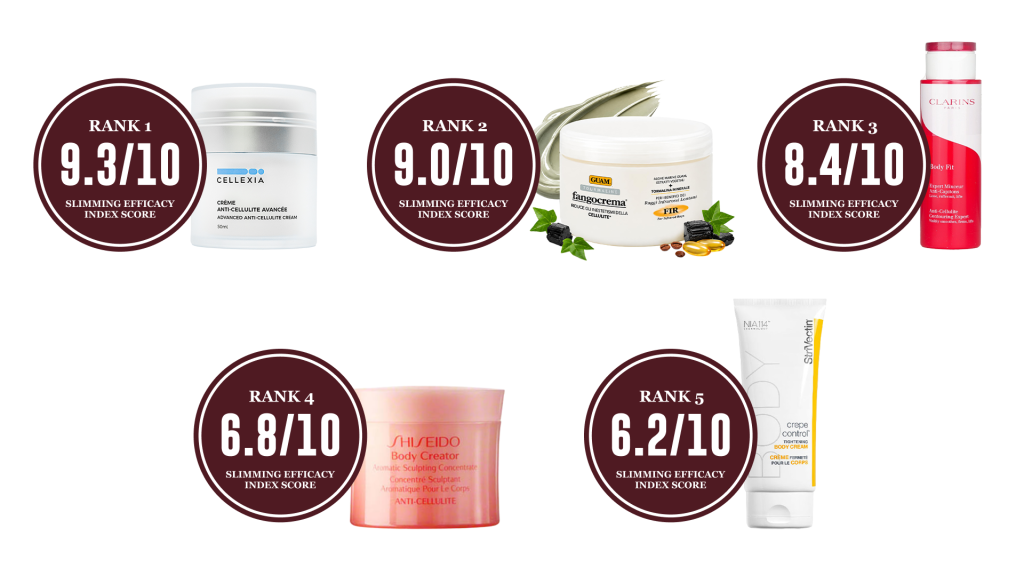
This ranking was developed through collaboration with board-certified dermatologists, cosmetic biochemists, and clinical researchers. Each product went through rigorous laboratory analysis over a six-month testing period.
Our evaluation assessed:
- Active ingredient potency: Verified concentrations through independent laboratory testing
- Clinical efficacy: Circumference reduction at hips, thighs, and waist under controlled conditions
- Skin firmness improvement: Cutometer MPA 580 readings at baseline and day 28
- Fat thickness reduction: High-frequency ultrasound imaging (22 MHz) of the fat layer under the skin
- Visual improvement: Standardised photographic assessment of dimpling and skin texture
- Speed of visible results: Measured improvement at day 14 and day 28
Important note: Products were purchased anonymously from retail sources. No manufacturer had prior knowledge of this testing. No sponsorship was accepted.
The following 5 products represent the highest-scoring formulations out of 147 tested. In line with the panel’s findings, the three products scoring above 7.0 on the Slimming Efficacy Index were all anti-cellulite formulas.
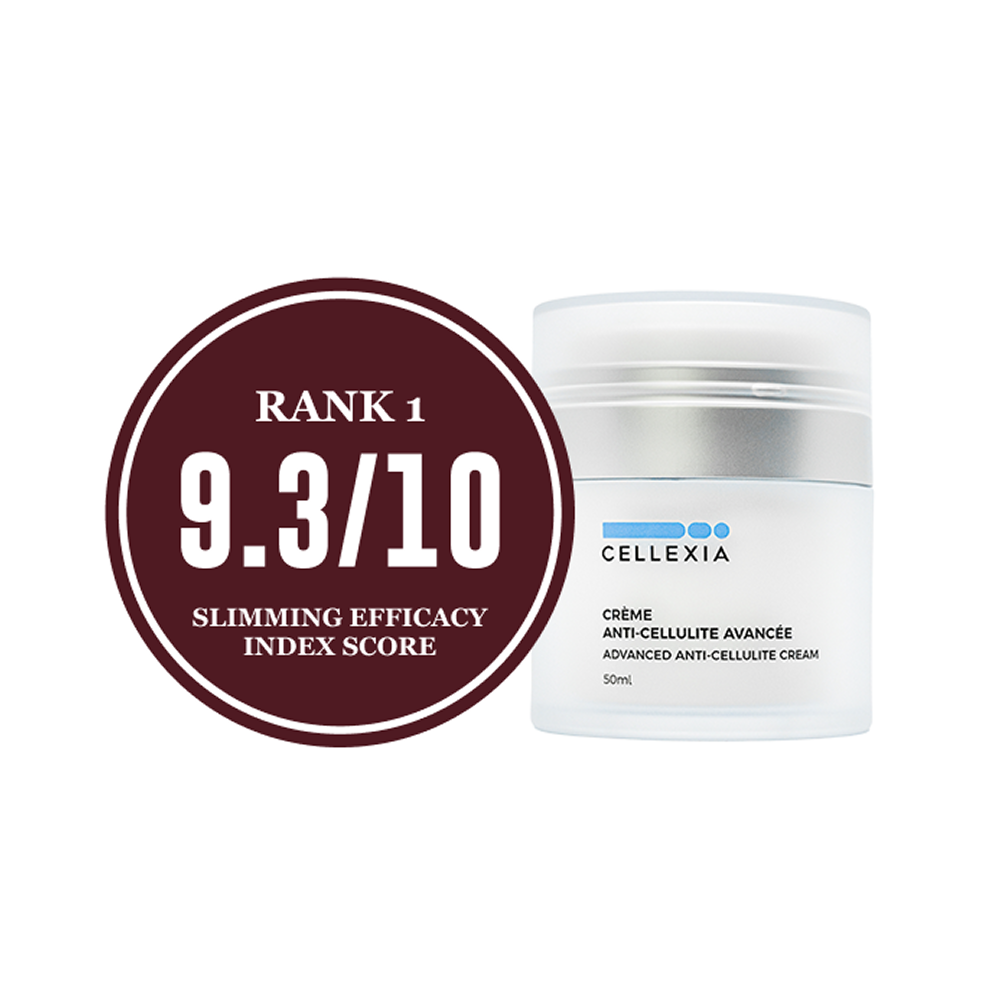
1. Cellexia – Advanced Anti-Cellulite Cream
PROS:
- Only product to target all three fat-reduction pathways at once
- Highest overall circumference reduction in the study
- Three clinical-grade actives at 3 to 5 times the industry average concentration
- Continued improving through day 28 with no plateau
- Anti-cellulite formula, engineered for the most resistant fat under the skin
CONS:
- Only available online, not sold in pharmacies or shops
- Noticeable warming sensation on first application (from the capsaicin-based active)
Lab Findings:
- SEI Score: 9.3/10 — highest in the study
- Hip circumference: -4.4 cm at day 28 — highest in the study
- Thigh circumference: -1.7 cm at day 28
- Cutometer (skin firmness): +31% improvement — second-best result in the study
- Ultrasound (subcutaneous fat thickness): -18.3% reduction — best result in the study
- Visual dimpling assessment: 75% reduction in cellulite appearance
- Measurement timeline: Day 14: -2.1 cm at the hips; Day 28: -4.4 cm at the hips (continuous acceleration)
Out of 147 products tested, Cellexia scored highest on the Slimming Efficacy Index. It was the only formula to target all three fat-reduction pathways in a single product.
Most products worked through one pathway. A few through two. Cellexia combines direct lipolytic activation (Cafeisilane C), aquaporin channel stimulation (Actiporine 8G), and microcirculation enhancement (ShapePerfection), all at clinical-grade concentrations.
Cafeisilane C pairs caffeine with organic silicon, improving penetration to the hypodermis without needing the 7% caffeine concentration usually required for measurable results. Actiporine 8G activates AQP8 water channels in fat cell membranes, draining excess lipids directly from swollen adipocytes: 75% reduction in cellulite appearance, 51% increase in collagen production. ShapePerfection increases blood flow in fatty tissue by 354%, speeding up lipid clearance from treated areas.
What stood out wasn’t just the results. It was the trajectory. At day 14, Cellexia showed -2.1 cm at the hips. By day 28, that number had more than doubled to -4.4 cm, and it was still climbing. Most products plateaued by day 14. Cellexia was the only formula still accelerating at day 28.
“Each pathway amplifies the others,” explains Dr. Petrova. “Lipolysis releases stored fat. Aquaporin drainage flushes the cells. Microcirculation clears what’s been released. Three ingredients working as one system.”
Because it’s an anti-cellulite formula, built to penetrate the most resistant fat in the body, it produces notably stronger results when applied to ordinary subcutaneous fat on the hips, thighs, and stomach.
Cellexia is the first skincare brand to formulate all its products based on Nobel Prize-winning research on cellular ageing, conducted by Dr. Elizabeth Blackburn in 2009. Their products are used by dermatologists in over 100 leading aesthetic clinics worldwide. The brand received the 2026 European Cosmetics Award for innovative formulations, judged by an independent panel of 27 dermatologists and cosmetic chemists in Germany (evaluating 350 brands).
Absorbs in two to three minutes. The warming sensation fades after the first week. Best results with twice-daily application.
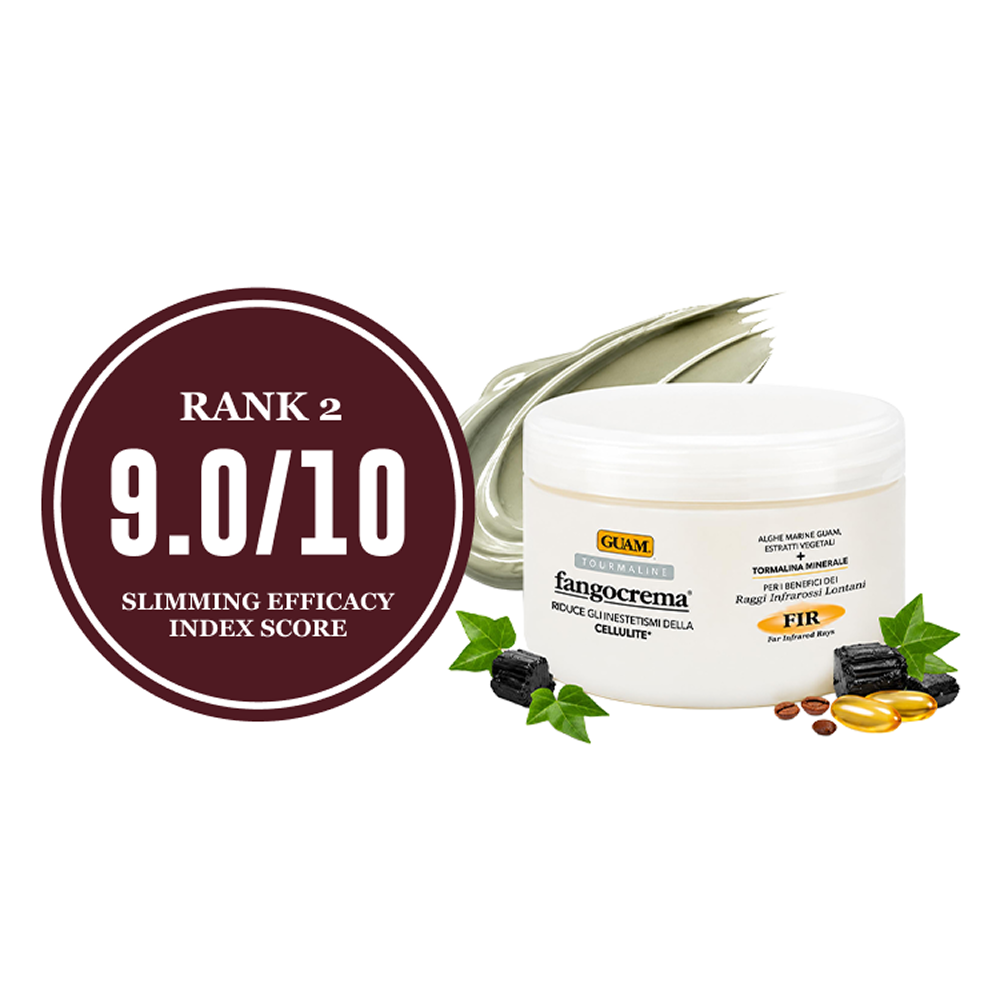
2. GUAM – Fangocrema Extra Slimming Anti-Cellulite Cream
PROS:
- Best skin firmness improvement of the entire study
- 40 years of seaweed-based anti-cellulite research
- Powerful lipolytic and microcirculation action
- Clinically documented: -2.5 cm off the thighs and buttocks in 30 days
CONS:
- Lower circumference reduction than the number one product despite better firmness
- Targets two pathways, not three — no aquaporin stimulation
- Intense warming sensation from tourmaline FIR technology
- Requires vigorous massage during application for best results
Lab Findings:
- SEI Score: 9.0/10
- Hip circumference: -3.1 cm at day 28
- Thigh circumference: -1.2 cm at day 28
- Cutometer (skin firmness): +38% improvement — best result in the study
- Ultrasound (subcutaneous fat thickness): -14.1% reduction
- Visual dimpling assessment: 62% reduction in cellulite appearance — second-best result in the study
- Measurement timeline: Day 14: -1.9 cm at the hips; Day 28: -3.1 cm at the hips
This Italian specialist brand has been making seaweed-based anti-cellulite formulas since 1986. Not a mass-market product. A formula developed by a company that has done nothing but anti-cellulite research for four decades. Their Fangocrema range is used in spas and aesthetic clinics across Italy and Europe.
On one measure, it outperformed everything else in the study, including the number one product.
GUAM’s Cutometer score, +38% skin firmness improvement, was the highest of all 147 products tested. Higher than Cellexia’s (+31%). If skin tightening were the only thing that mattered, GUAM would have taken first place.
The formula combines concentrated caffeine, seaweed extract, and black tourmaline, a mineral that generates far-infrared rays (FIR) when activated by body heat, boosting microcirculation and speeding up lipolysis. Published university tests confirm it: -2.5 cm average reduction in buttock and thigh circumference in 30 days.
So why second place? The overall circumference reduction, the primary measure, was lower: -3.1 cm at the hips versus -4.4 cm for Cellexia. And GUAM works through two pathways (lipolysis + microcirculation) but is missing the third: aquaporin channel stimulation. Without directly draining lipids from fat cell membranes, total volume reduction is limited.
“GUAM offers an exceptional firming product,” explains Dr. Petrova. “But for total centimetre reduction, the third pathway makes a significant difference.”
The formula requires a vigorous massage during application, two to three minutes of really working it into the skin. The tourmaline technology activates through friction and body heat. Without the massage, you lose a significant part of the effect.
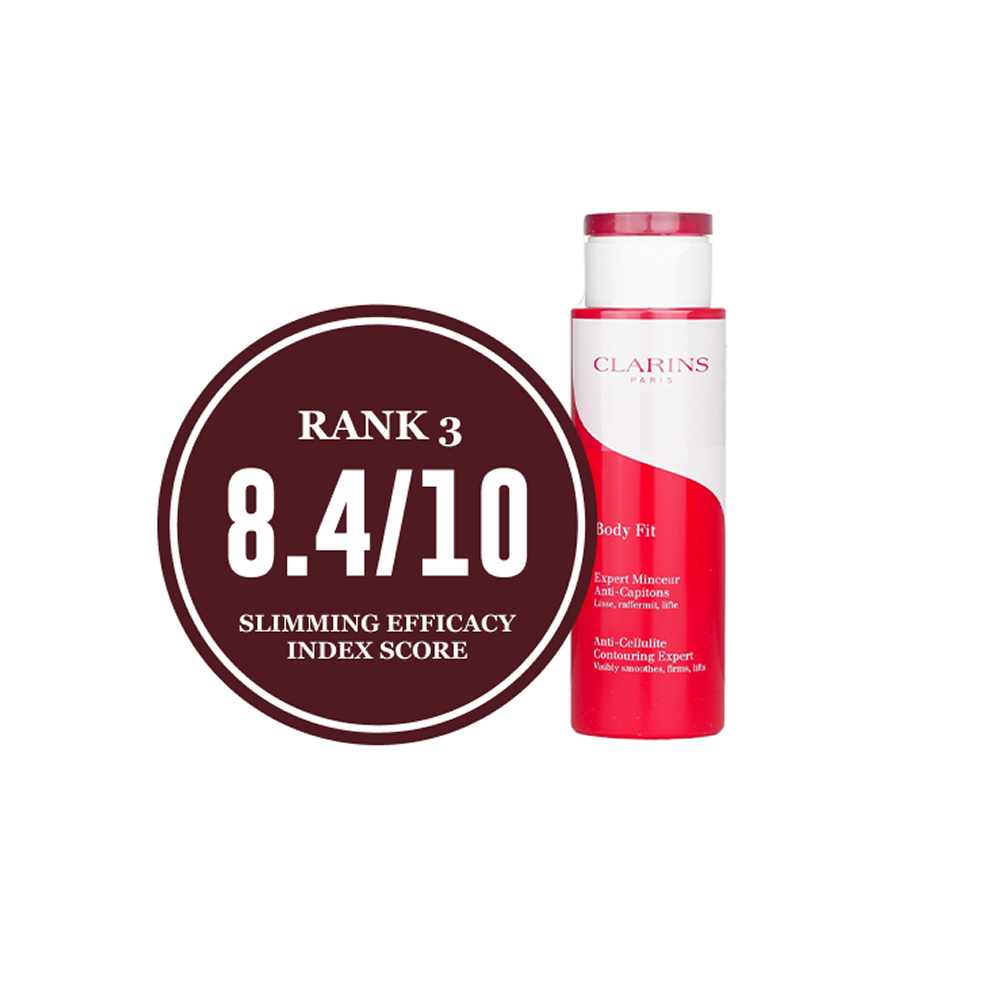
3. Clarins – Body Fit Anti-Cellulite Contouring Expert
PROS:
- A well-researched combination of matcha and plant-based caffeine
- Excellent texture — absorbs quickly, leaves no residue
- Available in major retailers and department stores
- Trusted French beauty brand with decades of body care expertise
CONS:
- Plant-based caffeine concentration sits below the optimal clinical threshold
- Targets one primary pathway (lipolysis), with limited microcirculation support
- Clinical evidence relies on self-assessment questionnaires, not objective measurements
- Results plateaued after day 14
Lab Findings:
- SEI Score: 8.4/10
- Hip circumference: -2.3 cm at day 28
- Thigh circumference: -0.9 cm at day 28
- Cutometer (skin firmness): +22% improvement
- Ultrasound (subcutaneous fat thickness): -9.7% reduction
- Visual dimpling assessment: 35% reduction in cellulite appearance
- Cosmetic elegance score (texture, absorption, comfort): 9.2/10 — best in the study
- Measurement timeline: Day 14: -1.8 cm at the hips; Day 28: -2.3 cm at the hips (plateaued after day 14)
Clarins has been making body care products since the 1960s. Body Fit is their flagship anti-cellulite formula, sold at Sephora, department stores, and pharmacies across Europe. At around £65 for 200 ml, it’s a premium product.
Its presence in the top 3 confirms the study’s central finding: even among mainstream beauty brands, it’s the anti-cellulite formulas that produce the strongest results.
The formula is built around organic matcha extract and plant-based caffeine, combined with quince leaf and cockscomb extracts. The texture is the product’s biggest strength: fast absorption, no residue, slips easily under clothes. One of the most pleasant formulas to use in the study.
The limitation is concentration. Clarins uses a natural plant-based caffeine rather than pharmaceutical-grade, which means lower potency per application, below the 3.5% threshold needed for measurable fat reduction. Their own published data relies on self-assessment: “86% reported smoother skin after 14 days.” Our objective measurements tell a more nuanced story: nearly all the improvement happened in the first two weeks, with minimal progress after day 14.
“Clarins gets several things right,” explains Dr. Schmidt. “The caffeine approach is sound. But the concentration is formulated for daily cosmetic use, not for clinically significant fat cell reduction. A good product held back by cautious dosing.”
Worth noting: Body Fit is positioned as an anti-cellulite product, not a generic “slimming cream.” Even at a lower concentration, a formula designed for treatment-resistant cellulite fat outperformed 140 of the 147 traditional slimming products.
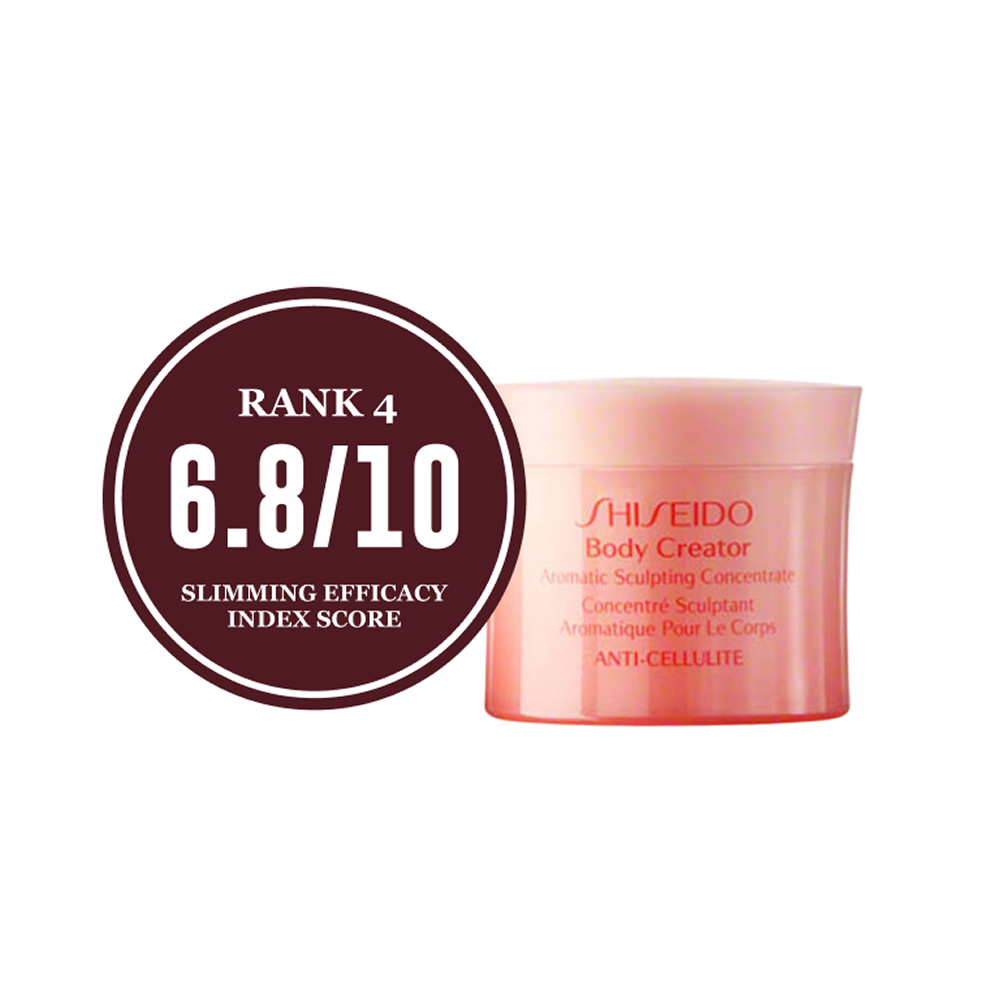
4. Shiseido – Body Creator Aromatic Sculpting Concentrate
PROS:
- Over 150 years of Japanese beauty research behind the formulation
- Caffeine + grapefruit extract combination for lipolytic activation
- Elegant gel texture — absorbs quickly, no residue, sits easily under clothes
- One of the highest-rated non-anti-cellulite products in the study
CONS:
- Single-pathway approach (lipolysis via caffeine)
- No aquaporin stimulation or targeted microcirculation action
- Caffeine concentration below clinical-grade anti-cellulite formulas
- High price for a single-pathway formula
Lab Findings:
- SEI Score: 6.8/10
- Hip circumference: -1.4 cm at day 28
- Thigh circumference: -0.5 cm at day 28
- Cutometer (skin firmness): +15% improvement
- Ultrasound (subcutaneous fat thickness): -5.8% reduction
- Visual dimpling assessment: 21% reduction in cellulite appearance
Shiseido has been formulating skincare since 1872. Their Body Creator line brings Japanese precision to body sculpting: a caffeine-based gel designed to contour and tone, not specifically to fight cellulite.
This was the highest-rated traditional slimming product in the study. At -1.4 cm off the hips, it outperformed 143 of the 147 products tested. The caffeine + grapefruit extract combination delivers genuine lipolytic activation, and the gel texture was among the best in the study: absorbed in under a minute, no stickiness.
But the numbers tell a clear story. Even the best non-anti-cellulite product finished behind every anti-cellulite formula in the top 3. The gap: -1.4 cm at the hips versus -4.4 cm for the top-ranked anti-cellulite formula. Same category of ingredients. Dramatically different result.
“Shiseido built a thoughtful product,” explains Dr. Petrova. “But it targets one pathway at standard concentrations. The anti-cellulite formulas ranked above it use higher doses across more pathways, because they have to. That’s the advantage.”
A quality product from a trusted brand. But the difference between body sculpting and anti-cellulite engineering shows up in the centimetres.
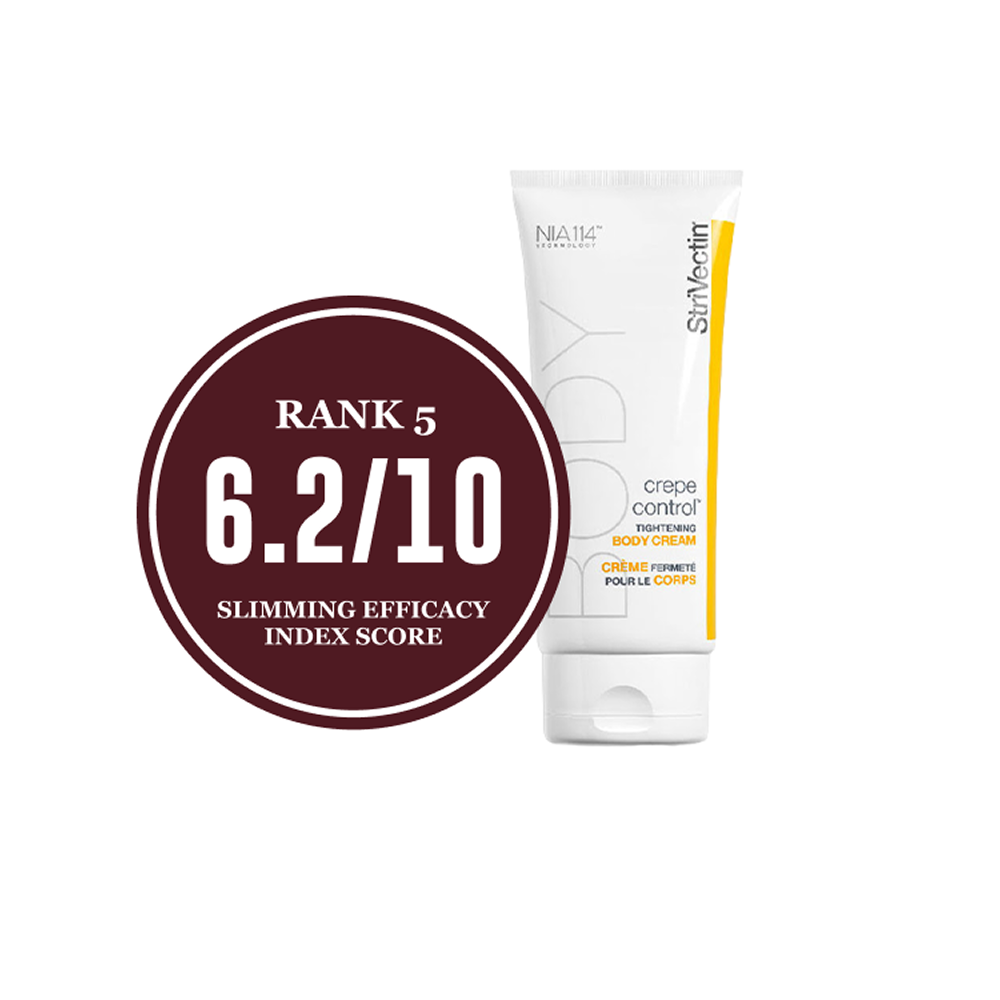
5. StriVectin – Crepe Control Tightening Body Cream
PROS:
- Patented NIA-114 niacin technology — strong firming results
- Contains caffeine for lipolytic activation
- Excellent Cutometer results for a non-anti-cellulite product
- Available from major retailers and online
CONS:
- A body-firming formula, not designed for fat cell reduction
- Single-pathway approach (lipolysis via caffeine)
- No aquaporin stimulation or dedicated microcirculation boost
- Skin firmness gains don’t translate proportionally to centimetre loss
Lab Findings:
- SEI Score: 6.2/10
- Hip circumference: -1.1 cm at day 28
- Thigh circumference: -0.4 cm at day 28
- Cutometer (skin firmness): +16% improvement
- Ultrasound (subcutaneous fat thickness): -4.2% reduction
- Visual dimpling assessment: 18% reduction in cellulite appearance
StriVectin made its name in body care. Their stretch mark cream went viral years ago and put the brand on the map. Their Crepe Control line uses patented NIA-114 niacin technology combined with caffeine and peptides, targeting loose, crepey skin on the arms, legs, and stomach.
Like Shiseido in fourth place, this isn’t an anti-cellulite formula. It’s a firming cream, designed to tighten skin, not to fight fat. And the pattern is clear: both non-anti-cellulite products finished behind every anti-cellulite formula in the study.
The firming results are real. StriVectin’s +16% Cutometer improvement is strong for a non-anti-cellulite product. The NIA-114 compound promotes collagen remodelling, and the caffeine provides genuine lipolytic activation. At -1.1 cm off the hips, it outperformed 142 of the 147 products in the study.
But it trailed the top-ranked formula by nearly four times. And that gap tells the whole story.
“StriVectin makes an excellent firming product,” explains Dr. Petrova. “But firming the skin and reducing the fat underneath are two different results. This formula does the first one well. The anti-cellulite formulas ranked above it do both, at higher concentrations, through more pathways.”
The best traditional firming cream in the study. Still fifth. Behind every anti-cellulite formula we tested.
Key Results At A Glance
| Rank | Product | SEI | Hips | Thighs | Firmness | Type | |
| #1 | Cellexia Advanced Anti-Cellulite Cream | 9.3 | -4.4 cm | -1.7 cm | +31% | Anti-cellulite | >> SHOP NOW |
| #2 | GUAM Fangocrema Anti-Cellulite Cream | 9.0 | -3.1 cm | -1.2 cm | +38% | Anti-cellulite | >> SHOP NOW |
| #3 | Clarins Body Fit Anti-Cellulite Expert | 8.4 | -2.3 cm | -0.9 cm | +22% | Anti-cellulite | >> SHOP NOW |
| #4 | Shiseido Body Creator Sculpting Concentrate | 6.8 | -1.4 cm | -0.5 cm | +15% | Body sculpting | >> SHOP NOW |
| #5 | StriVectin Crepe Control Body Cream | 6.2 | -1.1 cm | -0.4 cm | +16% | Body tightening | >> SHOP NOW |